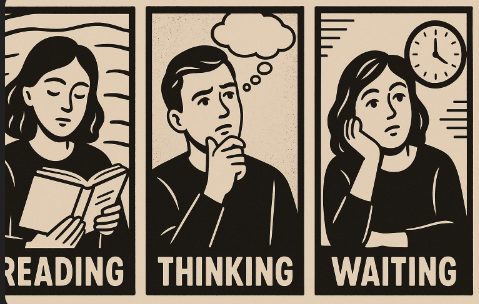
““We mostly just sit around reading, thinking and waiting.” — Stanley Druckenmiller
Like all the best investing quotes, this one manages to cram a lot of wisdom into a single line. In some ways it feels obvious, but it’s also easy to overlook. Especially in an era where many seem to think success means having eight monitors hooked up to a Bloomberg terminal and an arsenal of sophisticated software.
Druckenmiller’s point cuts against that whole idea. He’s saying the real edge comes from mastering three deceptively simple disciplines, and none of them can be sidestepped if you ever hope to achieve outsized returns.
Reading, of course, is where it begins. Study any of the investing greats and there’s always one thing they have in common: they are voracious readers. As the late Charlie Munger said, “In my whole life, I have known no wise people (over a broad subject matter area) who didn’t read all the time — none, zero.”
Reading is how you gather the dots that you will later connect. It’s how you build the raw material for judgment. And, importantly, it needs to be wide-ranging. Most people assume investing means devouring company reports, broker notes, and annual statements. And yes, they matter, but the best investors roam far and wide in their reading habits. They devour psychology, economics, politics, philosophy, sociology, science, technology, and much more, because markets are entangled with everything.
When you buy shares, you are buying a piece of a business, and that business exists in a messy, complex world. No set of financial statements or strategy documents will ever give you a complete view of that bigger picture.
There’s no formula and certainly no finish line here. The process is always ongoing, and the moment you stop is the moment you stop growing. And, just as importantly, you must read beyond your comfort zone to seek out ideas that challenge your assumptions, because reading only what confirms what you already believe doesn’t make you informed, it makes you brittle.
But gathering information is not enough. Thinking is where you connect the dots and turn knowledge into insight. You can read endlessly and still fail if you cannot process, integrate, and reflect. Great investors build what Munger calls a latticework of mental models. They take new information and fit it into a broader map of reality. They test it against what they already know, question its validity, and ask how it interacts with other forces.
In an age drowning in information, much of it contradictory or simply wrong, your job is to discern what lies closest to the truth. This is not about reciting theories or sounding clever. It’s about truly understanding how things work and continuously refining that understanding. The best investors are reflective and humble. They accept that certainty is rare and that their models are always evolving.
Underlying all of this is the necessity of independent thought. Markets are full of noise, and you cannot outsource your convictions. You must reach your own conclusions, informed by your own reasoning. Consensus thinking almost always leads to mediocre results. The real edge lies in having a variant perception, seeing something others don’t, or seeing it sooner.
Finally comes waiting, which is arguably the most difficult part. After you’ve read widely and thought deeply, you begin to recognise patterns. Occasionally, an opportunity emerges where the price is absurdly low relative to potential. But these moments are rare and unpredictable. You cannot force them. You have to wait for your fat pitch, as Buffett calls it.
Although when it comes, you can act decisively because your conviction is hard-earned. Yet even then, the waiting isn’t over. Once you’ve bought, you often need to wait years for your thesis to play out — the market does not move on your schedule. Sometimes you will be wrong. Often you will be early. Even when you are right, volatility will test your conviction. The discipline lies in doing nothing when doing nothing is the right thing, even as everyone else seems busy.
This process never ends. You can invest successfully for decades and still make mistakes. The world changes, industries evolve, and your mental models must evolve too. Reading, thinking, and waiting are not boxes to tick once but disciplines to revisit constantly. And in truth, this is not just about investing. It’s about life. To live well is to gather knowledge, reflect deeply, and act with patience. Wealth, if it comes, is a by-product of this approach, not the purpose of it.
So take a leaf out of Druckenmiller’s book. Read widely. Think rigorously. Wait patiently. Do that well enough, for long enough, and you give yourself a chance to do more than grow your wealth. You give yourself a chance to grow your understanding of the world. And that, in the end, is the real return.
Strawman is Australia’s premier online investment club.
Members share research & recommendations on ASX-listed stocks by managing Virtual Portfolios and building Company Reports. By ranking content according to performance and community endorsement, Strawman provides accountable and peer-reviewed investment insights.
Disclaimer– Strawman is not a broker and you cannot purchase shares through the platform. All trades on Strawman use play money and are intended only as a tool to gain experience and have fun. No content on Strawman should be considered an inducement to buy or sell real world financial securities, and you should seek professional advice before making any investment decisions.
© 2025 Strawman Pty Ltd. All rights reserved.