
Let’s talk about gold. That shiny yellow metal that’s captivated humans for thousands of years.
Traditionally seen as a ‘safe haven’ asset, its recent price action is more akin to that of a meme stock. Which is unusual in itself, but especially so when all other assets are likewise on their way to the moon.
So, what gives?
Maybe it’s just a good old fashioned speculative mania, a bubble waiting to pop. After all, gold doesn’t throw off any cash flow, has limited industrial use, and mostly just sits in vaults doing sweet bugger all. Sure, it looks nice on a necklace, but is it really that much better than polished stainless steel? Be honest.
You can’t buy groceries with it. You can’t send it over the internet. It’s tricky to verify and expensive to store — a total nightmare in any practical sense. No wonder most see it as a quaint anachronism, entirely unfit for the digital age.
Still, it does seem to be quite good at preserving value. Which is what, I think, is attracting buyers.
Despite all its limitations, gold does have a few characteristics that make it special. Mainly, it’s scarce, you can’t easily produce more of it, and it has the longest track record of any asset. Centuries of social proof give it a credibility most assets can only dream of.
Normally, at least for us privileged few in the developed world, those traits don’t count for much when the money we use is likewise somewhat restricted in quantity. Especially when it also confers all manner of other advantages.
But that’s increasingly a difficult assertion to make.
The US dollar, the largest, most liquid and widely accepted of the fiat currencies — not to mention the global reserve currency — has, on average, increased in quantity by about 7% per annum over the last 30 years. That compares to an annual inflation of roughly 2-3% for gold.
Moreover, the rate of new issuance has been accelerating, and with notable jump in the wake of various crises such as the GFC and COVID.
Get this: almost 30% of all US dollars in existence were created after 2020.
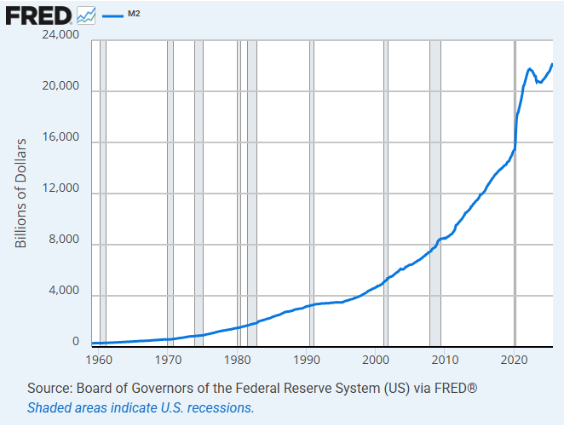
The main reason we didn’t notice too much inflation over this period, or at least persistent inflation, is because productivity growth helped soak it up. And if you owned stocks or property, rising asset prices did the rest.
But that’s not true for most people. For the billions living under dysfunctional regimes like Argentina, Egypt or Libya, the story is one of constant currency debasement and the grinding poverty that follows. For them, gold’s appeal is obvious. Even a bloated US dollar is better than the local stuff.
But now, the cracks are showing in the developed world too. As productivity slows, Western economies are getting a taste of what happens when money starts to wobble. Asset bubbles form. Wealth inequality rises. Inflation flares. Populism grows. And then there’s the debt…
The US national debt is now 38 trillion dollars. Servicing that debt is the second biggest line item in the federal budget, ahead of defense. And the US spends a LOT on defense. Debt-to-GDP is sitting at 123%, worse than it was after World War II. The annual deficit is about 7% of GDP and trending the wrong way. Add in geopolitical tensions, demographic headaches, and fragile trade relationships, and suddenly the US dollar doesn’t look quite so invincible.
There are only two real ways out. Default and trigger a depression. Or print more and trigger inflation (likely a lot of inflation). Neither is great, but one is politically far more palatable, even if the end result is to socialise the losses across the wider society. But that mainly impacts poor people, so who cares! Right?
Of course, macro ‘doomers’ have been banging this drum for decades and following their advice would have done you no favours. But every time we opt for the money printer to bail us out, we just push the structural problems further down the road. And the further we kick the can, the heavier it gets.
That’s not to suggest a crisis is imminent. But, don’t be surprised where you end up if you never change direction.
Gold is getting bid up because people are starting to wonder if the emperor’s currency has no clothes. It’s not that irrational. In fact, the lessons of history would suggest it’s somewhat prudent.
Of course, maybe we get our fiscal and monetary affairs in order. Perhaps we experience a productivity miracle that allows us to grow our way out of trouble. Or maybe any reckoning remains far off.
You certainly don’t need to panic and join the throng of people lining up to buy bars of gold. But you can take some sensible steps to ensure you fair better than most. Best of all, if no monetary crisis eventuates, it’ll probably still be a good move.
Specifically, endeavour to own scarce, productive or desirable assets. Think quality businesses, land, and yes, even gold. Maybe even digital gold.
Anything except cash or bonds. That is where purchasing power goes to die in such times.
Of course, you may still suffer losses in real terms if any economic reckoning is had, but these things hold up much better when inflation hits. Everything is relative.
Oddly enough, a bit of debt can also help, if it’s the right kind. Not debt for consumer junk. But manageable, asset-backed debt, like against your home, can be a powerful tool. Over time, the real value of debt falls, while the real value of quality assets rises. That’s why people like Musk and Gates have loans, and very little of their wealth is held in cash, or cash equivalents. They’re not broke. They just know how the game is played.
Whatever you do, don’t hoard cash. Or cuddle up to so-called “safe” assets like bonds. Sure, they wear the “risk-free” label like a badge of honour, but they’re only as reliable as the bureaucrats and central bankers running the show. And these days, those institutions are less stewards of stability and more political playthings with a knack for breaking the very trust they expect us to place in them.
Strawman is Australia’s premier online investment club.
Members share research & recommendations on ASX-listed stocks by managing Virtual Portfolios and building Company Reports. By ranking content according to performance and community endorsement, Strawman provides accountable and peer-reviewed investment insights.
Disclaimer– Strawman is not a broker and you cannot purchase shares through the platform. All trades on Strawman use play money and are intended only as a tool to gain experience and have fun. No content on Strawman should be considered an inducement to buy or sell real world financial securities, and you should seek professional advice before making any investment decisions.
© 2025 Strawman Pty Ltd. All rights reserved.