Top member reports
Consensus community valuation
The consensus valuation is for members only and has been removed from this chart. Click for membership options.
Contributing Members
Content is delayed by one month. Upgrade your membership to unlock all content. Click for membership options.
#COO Interview
stale
Last edited 7 months ago

Here's the transcript from today's meeting with BlinkLab (ASX:BB1) co-founder and COO Anton Uvarov. (The CEO is in the Netherlands and didnt realise the timezone when he accepted the interview).

BlinkLab Transcript.pdf

Still, Anton clearly knew the business well and laid out the key insights well. Below are some bullet points from the discussion from my mate chatGPT. Before that, my general view is that the technology seems super interesting and is clearly aimed at a very large addressable market and, if it delivers, one that should vastly accelerate diagnosis of conditions like ADHD and Autism, as well as save clinicians and insurers some time and money (always a nice selling point). But, as Anton said, it's all about execution now and the current FDA trial is a "binary outcome" (the business is sunk if it fails). If it does pass, and of course Anton thinks it will, there's still going to be a lot of work in the commercialisation. Still, IF the FDA hurdle is cleared, AND they commercialise well, this is likely a billion dollar plus company in years to come.

Problem & Purpose

  • BlinkLab aims to bring diagnosis of neurodevelopmental conditions like autism and ADHD earlier, ideally around age 2, rather than the typical 4–5 years.
  • Early detection enables effective interventions (like ABA therapy), which can significantly improve long-term outcomes and reduce lifetime care costs.

Technology & Approach

  • The BlinkLab Dx1 app uses a smartphone camera to measure involuntary micro-reflexes (e.g., blinking, head movement) in response to stimuli.
  • These reflexes act as digital biomarkers; the system employs AI and supervised machine learning to detect diagnostic patterns.
  • The solution digitizes and automates well-established clinical tests that were previously cumbersome and manually analysed.
  • Currently tracks 400+ facial features per session; over time, this data helps refine and expand their diagnostic capabilities.

Moats & IP

  • BlinkLab holds 7+ patents covering its biomarkers and testing methodology.
  • Its data advantage compounds over time—each test generates thousands of data points, enabling continuous model refinement.
  • As usage scales, so does their proprietary dataset and clinical insight, creating barriers to entry for competitors.

Milestones & Clinical Progress

  • Currently conducting the largest U.S. digital autism diagnostic study, with 10+ prestigious sites being onboarded.
  • Targeting FDA 510(k) clearance for autism in 2026, followed by ADHD.
  • A large European ADHD study is also underway, with data expected shortly to inform a U.S. ADHD study design.

Go-To-Market & Reimbursement

  • Strategy focuses on primary care physicians for early screening—leveraging their scale and regular interaction with children.
  • Goal is to obtain reimbursement codes from CMS post-FDA clearance; this is crucial to avoid out-of-pocket costs for families.
  • BlinkLab is also educating clinicians by involving key opinion leaders and top clinical centres during the trials.

Business Model

  • Initially a per-use model (e.g., per screening visit), aligned with U.S. pediatric guidelines recommending autism checks at 18 and 24 months.
  • Potential for future recurring revenue via therapy monitoring, allowing clinicians to track progress in real-time.
  • Scalable by design—no special hardware, just an app using iPhones’ built-in capabilities.


Thanks @SayWhatAgain for suggesting the company, and for some excellent questions.

Read More
Valuation of $0.520
stale
Edited 8 months ago

Hi Straw People (do we have any SW in our little community?) 

Been looking into BlinkLab (ASX:BB1) – an early-stage Australian health tech developing an AI-powered, smartphone-based diagnostic tool for autism, ADHD and other neurodevelopmental conditions. Its technology has shown superior accuracy to FDA-approved alternatives, and with U.S. trials underway and regulatory approval expected in 2026, it is positioned to enter a large, underserved global market. Its backed by strong patents, reputable research partnerships (including Princeton and Monash), and a scalable, software-only model, BB1 offers significant upside as it transitions from clinical validation to commercialisation. I’m also thinking of possibilities down the line from players like Apple Health, given their move into biometric and neurological screening.

I like the company. It is largely founder-led, with the CEO, CTO, CSO and COO all being co-founders who helped develop the core neuroscience and software platform behind the product. The chairman, Brian Leedman (https://www.blinklab.org/investors), brings added credibility, having co-founded ResApp Health, a digital diagnostic company that was acquired by Pfizer for A$180M. The leadership team is well-aligned, technically strong, and has a track record of innovation and commercial success.

Of course, despite its promise, it’s not all blue skies — BlinkLab is a pre-revenue company with no regulatory clearance yet, limited cash reserves, and a likely need for shareholder dilution before revenue begins. Clinical adoption could be slow, and success depends not just on approval but also on changing entrenched diagnostic behaviours in healthcare — a challenging and uncertain path. That said, considering how many neurological conditions are still diagnosed subjectively and with long delays, BlinkLab offers a faster, cheaper, and more quantitative diagnostic alternative.

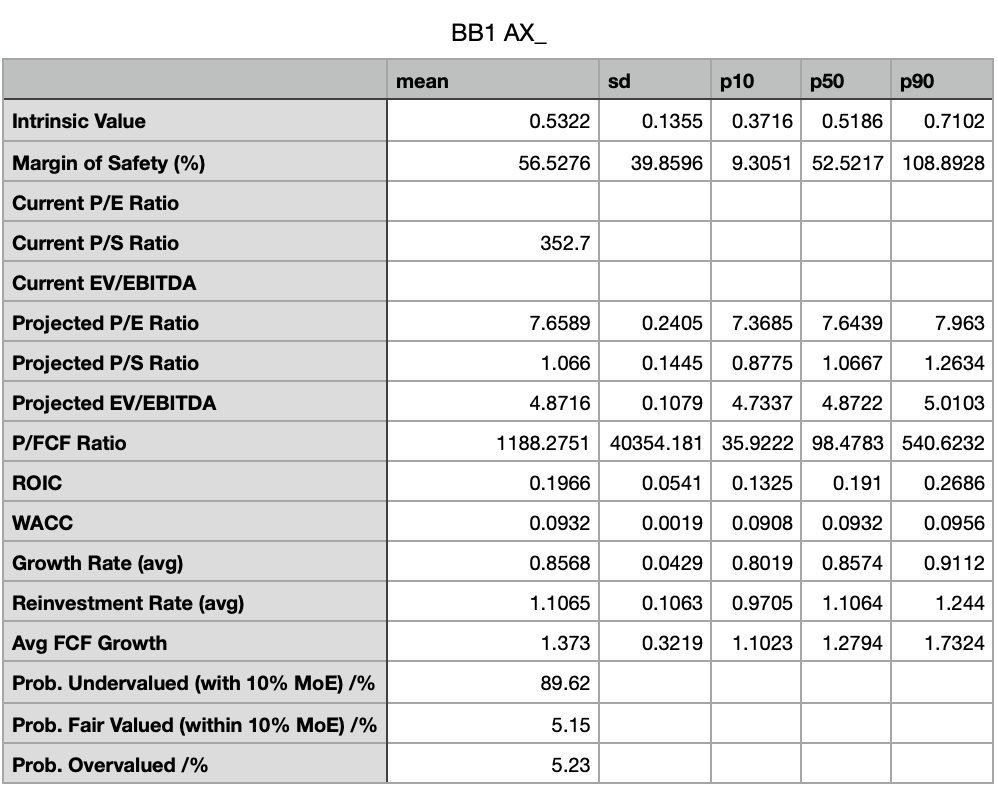
So, I ran a DCF using exponential growth fade assumptions and high reinvestment. Based on a high-growth revenue trajectory, the model estimates an intrinsic value of $0.52 per share (range: $0.37 to $0.71, 10th–90th percentile) compared to the current price of $0.35. This implies a margin of safety of ~56% (range: 9% to 108%). That places BB1 in a deep discount valuation category, reflecting high potential — if execution milestones are met. In terms of capital efficiency, BB1 is compelling. The model assumes a high-growth return on capital (ROC) of ~79%, which compares favourably to top-tier SaaS firms (60–80%), and well above average software (25–40%) or healthtech (15–25%) benchmarks. Even in the stable phase, BB1 is expected to generate a ROC of 13% and a ROIC of ~19%, exceeding mature software and medtech averages. Thus, BlinkLab could scale rapidly and profitably without requiring heavy capital.

Have any of you looked at BB1? and whether you had any thoughts. SW, I also thought a meeting with BB1 would be cool.

Cheers!
fe660d81daeebc47401fba01a756af0e96fbb0.png


Read More