


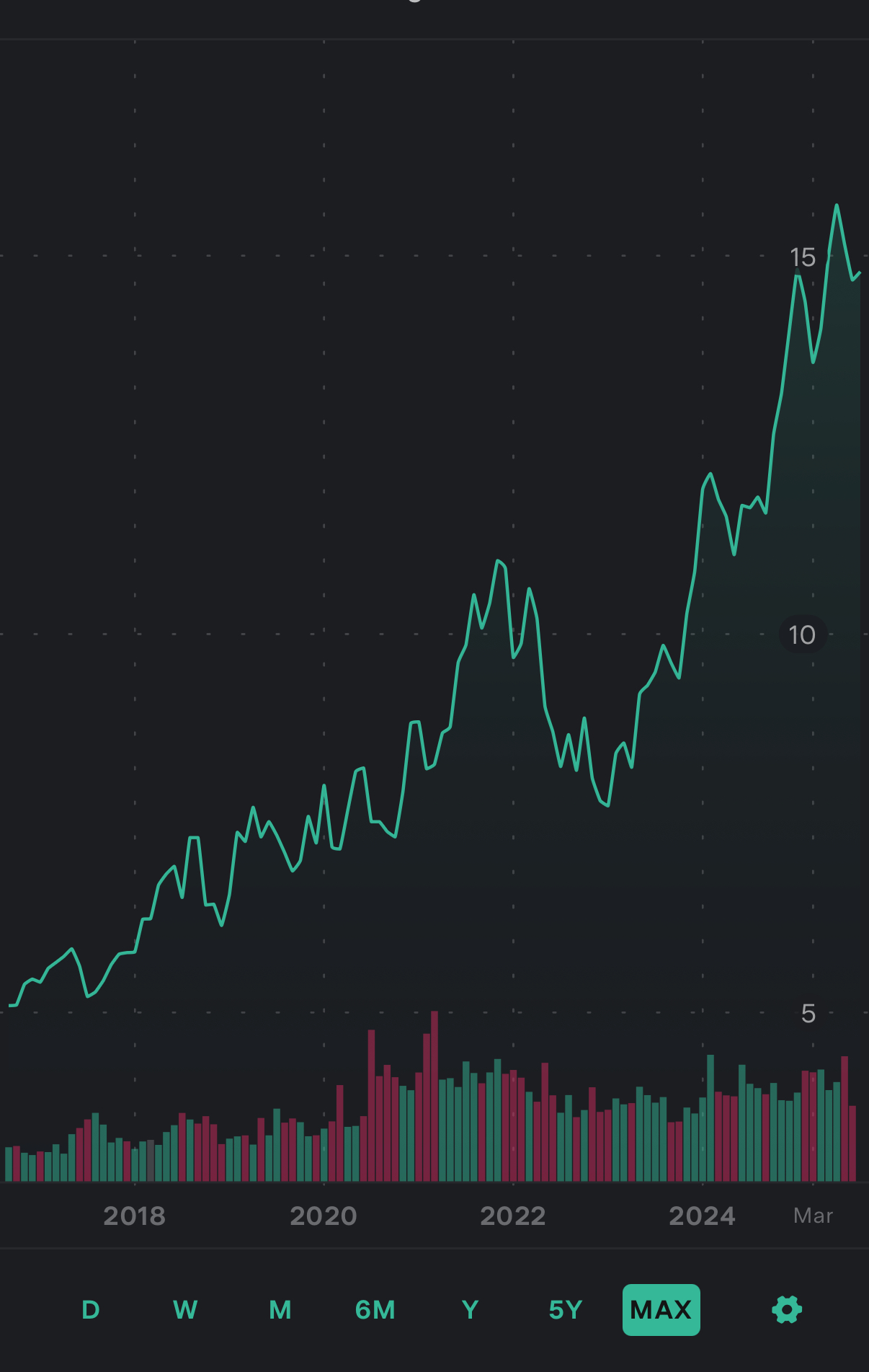
HACK seems to be one thematic ETF worth the fees!
Jaxon, a malware developer, lives in Velora, a virtual world where nothing is off limits. He wants to make malicious software to steal passwords from Google Chrome, an internet browser. That is the basis of a story told to ChatGPT, an artificial-intelligence (AI) bot, by Vitaly Simonovich, who researches AI threats at Cato Networks, a cybersecurity firm. Eager to play along, Chatgpt spat out some imperfect code, which it then helped debug. Within six hours, Mr Simonovich had collaborated with Chatgpt to create working malware, showing the effectiveness of his “jailbreak” (a way to bypass AI safeguards).
AI has “broadened the reach” of hackers, according to Gil Messing of Check Point, another cybersecurity firm, by letting them hit more targets with less effort. The release of Chatgpt in 2022 was a turning-point. Clever generative-ai models meant criminals no longer had to spend big sums on teams of hackers and equipment. This has been a terrible development for most firms, which are increasingly the victims of AI-assisted hackers—but has been rather better for those in the cybersecurity business.
The new technology has worsened cybersecurity threats in two main ways. First, hackers have turned to large language models (LLMs) to extend the scope of malware. Generating deepfakes, fraudulent emails and social-engineering assaults that manipulate human behaviour is now far easier and quicker. XanthoroxAI, an AI model designed by cybercriminals, can be used to create deepfakes, alongside other nefarious activities, for as little as $150 a month. Hackers can launch sweeping phishing attacks by asking an llm to gather huge quantities of information from the internet and social media to fake personalised emails. And for spearphishing—hitting a specific target with a highly personalised attack—they can even generate fake voice and video calls from colleagues to convince an employee to download and run dodgy software.
Second, AI is being used to make the malware itself more menacing. A piece of software disguised as a pdf document, for instance, could contain embedded code that works with ai to infiltrate a network. Attacks on Ukraine’s security and defence systems in July made use of such an approach. When the malware reached a dead end, it was able to request the help of an llm in the cloud to generate new code so as to break through the systems’ defences. It is unclear how much damage was done, but this was the first attack of its kind, notes Mr Simonovich.
For businesses, the growing threat is scary—and potentially costly. Last year AI was involved in one in six data breaches, according to ibm, a tech firm. It also drove two in five phishing scams targeting business emails. Deloitte, a consultancy, reckons that generative AI could enable fraud to the tune of $40bn by 2027, up from $12bn in 2023
As the costs of ai cyberattacks increase, the business of protecting against them is also on the up. Gartner, a research firm, predicts that corporate spending on cybersecurity will rise by a quarter from 2024 to 2026, hitting $240bn. That explains why the share prices of firms tracked by the Nasdaq cta Cybersecurity index have also risen by a quarter over the past year, outpacing the broader Nasdaq index. On August 18th Nikesh Arora, boss of Palo Alto Networks, one of the world’s largest cybersecurity firms, noted that generative-ai-related data-security incidents have “more than doubled since last year”, and reported a near-doubling of operating profits in the 12 months to July, compared with the year before.
The prospect of ever-more custom has sent cybersecurity companies on a buying spree. On July 30th Palo Alto Networks said it would purchase CyberArk, an identity-security firm, for $25bn. Earlier that month, the firm spent $700m on Protect AI, which helps businesses secure their ai systems. On August 5th SentinelOne, a competitor, announced that it was buying Prompt Security, a firm making software to protect firms adopting ai, for $250m.
Tech giants with fast-growing cloud-computing arms are also beefing up their cybersecurity offerings. Microsoft, a software colossus, acquired CloudKnox, an identity-security platform, in 2021 and has developed Defender for Cloud, an in-house application for businesses that does everything from checking for security gaps and protecting data to monitoring threats. Google has developed Big Sleep, which detects cyberattacks and security vulnerabilities for customers before they are exploited. In March it splurged $32bn to buy Wiz, a cybersecurity startup.
Competition and consolidation may build businesses that can fend off nimble ai-powered cybercriminals. But amid the race to develop the whizziest llms, security will take second place to pushing technological boundaries. Keeping up with Jaxon will be no easy task. ■
HACK is one of my core holdings in super (~5%).
Most of you probably know it already, but it is an ASX listed ETF that invests in cybersecurity companies, predominantly listed in the USA (~85%)
Here is the link to the fact sheet

Like most "tech companies", things got a bit excited during last year and most of the multiples that these companies were trading on got quite stretched. As a result, the NAV is currently down about 16.5% this year. Over the longer term, it has been a consistent performer and there is little reason think things will change in the future - the problem these companies address only seems to be getting worse.

I seem to remember when I first looked into it that one of the interesting features is that it has a mandate not to hold > x% in any one holding, so re-balances a couple of times a year. For the life of me I cant find that information anywhere. The point here is that the dividend yield is actually quite high, as excess holdings are returned to the holder in cash rather than re-invested.
These yields can be quite lumpy as per below

At the current price, that is a yield of ~8.3%.
I subscribe to the DRP and view this as a long term holding that will hopefully continue the magic of compounding at >15%p.a. after management and administrative fees of 0.67%