We tend to judge a decision’s quality by its outcome rather than by the information available when it was made. It’s a bias professional poker player and author Annie Duke calls “resulting.”
It’s an easy mistake to make, and a dangerous one. Especially in the game of investing where it’s not uncommon to see bad decisions rewarded, and good decisions punished.
Captain Hindsight will always know exactly what you should have done, but he only ever shows up long after you had to make the call. Once we know how something turned out, it feels like it was always going to turn out that way. The dots connect themselves retrospectively with a clarity that was simply not available in the moment. History tends to read like inevitability, not one of many possible trajectories.
A good decision, properly understood, is one that made sense given what you knew at the time. That’s not to offer a crutch for us to lean on when things go bad, mind you. There are plenty of times when, if we’re being honest with ourselves, we could’ve and should’ve been able to make a better decision. But no matter how thorough our analysis and thinking, we’re always going to be forced into making decisions with an incomplete view of the future.
It’s only when you ignore available evidence, cut corners, or simply succumb to greed or fear that you can rightly beat yourself up.
Likewise, you should avoid patting yourself on the back when things go well for reasons you never initially envisaged. Buying a stock a day before a huge takeover offer lands may give you a quick profit, but that’s pure luck. Take the win, for sure — just don’t pretend you’re a visionary thinker who can see around corners.
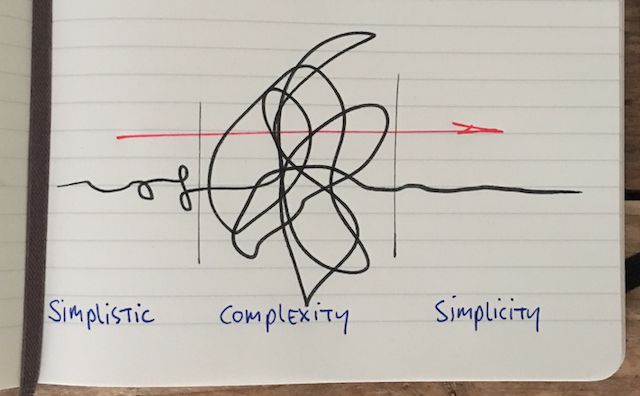
Another thing to be mindful of is that good decisions account for the non-linearity of life. Big technological and structural shifts tend to happen in an exponential and discontinuous fashion, which means a simple extrapolation of the present can lead you to miss the truly big investment opportunities.
Remember, if the future is obvious then it is almost always already priced. The biggest payoffs accrue to those who act before the fog has fully cleared, which means acting under uncertainty, with incomplete information, and knowing the outcome will almost never unfold exactly as you anticipate.
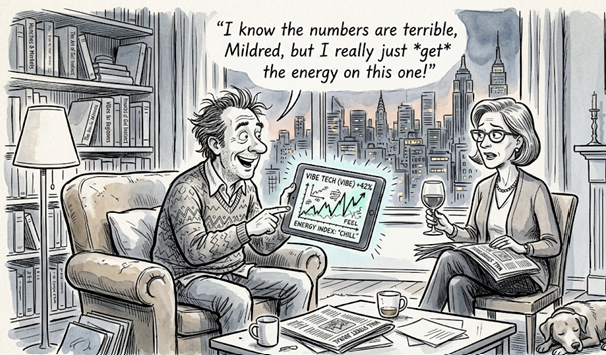
Another insidious trap is to form an irrational loyalty to an idea. Once we have publicly committed to a thesis, or simply held a position long enough, the thesis often becomes part of our identity. We stop evaluating it and start defending it, mainly for the preservation of our ego (I’m more guilty of this than anyone). New information gets filtered through the lens of what we already believe, and we unconsciously downweight whatever contradicts us. We become a slave to our narrative.
The remedy is to hold onto your ideas loosely; to treat every investment thesis as a working hypothesis subject to revision. And, importantly, to distinguish between changing your mind because the facts changed and changing your mind simply because of volatility or a shifting market sentiment.
The thing is, good investing requires a kind of epistemic hygiene that runs against most of our instincts. We want certainty. We expect good decisions to always be rewarded. But the market is under no obligation to pander to our silly human desires.
Rather, it rewards process. Because good process, while never guaranteeing success, means you are playing with loaded dice. And that’s a game you should be willing to play as long as you can.
Strawman is Australia’s premier online investment club.
Members share research & recommendations on ASX-listed stocks by managing Virtual Portfolios and building Company Reports. By ranking content according to performance and community endorsement, Strawman provides accountable and peer-reviewed investment insights.
Disclaimer– Strawman is not a broker and you cannot purchase shares through the platform. All trades on Strawman use play money and are intended only as a tool to gain experience and have fun. No content on Strawman should be considered an inducement to buy or sell real world financial securities, and you should seek professional advice before making any investment decisions.
© 2026 Strawman Pty Ltd. All rights reserved.