There is precisely one way for an entrepreneur to know if there is actual demand for their product or service: put it out there.
They must run the experiment to see if the open market validates their hypothesis. Focus groups and market research are fine, but true validation only happens when customers willingly and repeatedly part with their hard-earned cash.
Crucially, this involves the real risk of permanent capital loss. Get it wrong, and you are worse off and less able to try again. This is exactly why the profit motive is so vital. Why else would anyone take on a highly uncertain proposition if there were no upside to being right?
It is also why there is virtue in a fairly earned profit. It represents proof that the entrepreneur offered something others valued, at a price they were willing to pay, and more efficiently than others — all at their own risk. If there is a “victim” here, it is only the competitor less able to satisfy those desires, and the investors who backed them.
When business owners are proven right, it is a good thing the market rewards them. This reward serves as the initial inducement to solve problems and gives them the financial capacity to run more experiments in the future. If they pull the rabbit out of the hat again, everyone is better off. If they can’t, they cop the loss and capital is redistributed to where it is more valued.
At an individual level, financial loss is unpleasant; good people with great intentions fail all the time, often due to bad luck. It is nothing to revel in. Nevertheless, from a broader perspective, loss functions as a vital course-correction mechanism for resource allocation. It ensures society does fewer things nobody wants, and more things they do. Meanwhile, the entrepreneur learns a valuable lesson to have a better chance next time.
That is a good thing.
Free markets do not guarantee everyone wins; that is impossible. Instead, they maximise positive outcomes for the greatest number of people by letting them transact exactly how they deem appropriate.
But let’s pull up here and avoid the deeper philosophy of free markets. There is a very practical dimension to this if you fancy yourself a stock picker. As an investor, you are in a very similar position to the entrepreneur.
You are likewise looking into an uncertain future, trying to intuit what people will come to value. You are just one step removed, in that you also need to divine whether the management team claiming to deliver that value will actually do so, and to a degree that justifies the cost of your stake.
You can employ all the spreadsheets and financial analysis in the world, but the only way to know if your instincts are right is to place your bets and let the situation unfold.
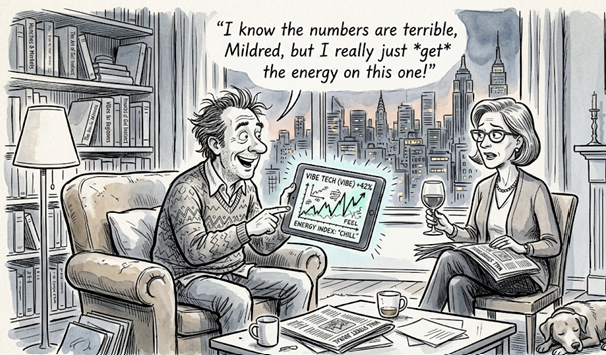
The term “vibe investing” seems about right. Because as analytical as you try to be, there is always an element of good old-fashioned gut instinct.
The history of business is littered with brilliant ideas that felt like they should have been massive successes — the Segway, laserdiscs, orbital engines, or innovations closer to home like AI-focused speech encoders, remote sensing fibre optic cables, and drone protection systems. Maybe their time will come, but we can only know after the fact. Each year that passes without validation makes the initial hypothesis less reasonable.
Could’ve, would’ve, should’ve. But didn’t.
That’s fine. Like the failed entrepreneur, there are valuable lessons to be had that increase the odds of success on the next try.
But you only know by having tried.
There simply is no certainty when it comes to investing and, at a point, you just have to go with the vibes, man.
Strawman is Australia’s premier online investment club.
Members share research & recommendations on ASX-listed stocks by managing Virtual Portfolios and building Company Reports. By ranking content according to performance and community endorsement, Strawman provides accountable and peer-reviewed investment insights.
Disclaimer– Strawman is not a broker and you cannot purchase shares through the platform. All trades on Strawman use play money and are intended only as a tool to gain experience and have fun. No content on Strawman should be considered an inducement to buy or sell real world financial securities, and you should seek professional advice before making any investment decisions.
© 2026 Strawman Pty Ltd. All rights reserved.