A friend of mine was giving me a bit of grief about Bitcoin the other day. In particular, the fact that I was “investing in something that is entirely intangible, abstract, and made up.” Moreover, its market value was entirely dependent on a shared delusion being effectively sustained.
(Before you scroll past this, let me quickly add: this is not a sermon on magic internet tokens! That’s just where the story starts.)
And honestly, I get it. He’s got a point. It is all of those things.
But what my mate failed to realise is that you can say the same about most of the things we humans value. Ideas like human rights, free speech (and dare I say organised religion) for starters; but even within the financial realm, the reality is that most of what we value as investors is mostly ethereal.
Given he works in equities, he should know better.
While we take it for granted today, the very concept of a joint-stock company was a paradigm-shifting breakthrough that allowed for the private organisation of capital and labour, and the distribution of the associated risk and reward, in a manner that was previously impossible. It was a massive unlock in our civilisational tech-tree that provided a degree of agency previously only available to emperors and kings under the threat of violence.
Indeed, as many have argued, something as profound as the Industrial Revolution would have been nearly impossible without this organisational framework (especially thanks to the “limited liability” upgrade of the mid-nineteenth century).
But the point is, a company is entirely a legal fiction. It exists only in our shared consciousness, on paper, or on digital registries. And its value is built entirely on the expectation that its legal status and powers will be effectively sustained and enforced into the future.
Yes, companies tend to own tangible things: buildings, factories, equipment, inventory. But this typically makes up only a small portion of a company’s market value. Even for asset-heavy businesses, the physical asset carrying value is usually only a small part of the total market value.
When you buy shares, you are securing part ownership in an entity — an idea — around which people coordinate to try and generate real-world value. And that value itself is increasingly likely to be intangible. In fact, most of the biggest companies in the modern world are built around software. Pure information that can no more be held or touched than Bach’s Brandenburg Concertos or Newton’s equations.
If Alphabet (NASDAQ:GOOG) sold all of its physical stuff, it would receive something like ~US$380 billion — about 10% of its current market value.
Don’t even get me started on bonds. There’s nothing even remotely tangible that underpins them, and yet, as an asset class, it is one of the largest in the world.
To be clear, I’m not mocking any of this. There is clearly incredible utility in something that can effectively coordinate large numbers of strangers to strive towards a common goal. It’s just that it’s so familiar and normalised that we don’t even think about it. And you don’t need to convince anyone of the value of these things because, well, it’s obvious.
I’m just making the point that most of the world’s value, as measured by market prices, lies with the intangible. I’d go as far as to argue that it is our capacity as humans to operate in the abstract that most distinguishes us from other animals. I always liked how Alasdair MacIntyre put it: “Man is in his actions and practice, as well as in his fictions, essentially a story-telling animal.”
And this is no more true than in the financial arena. Nobel Laureate Robert Shiller essentially argues as much in his book Narrative Economics. We may like to pretend at times that the current market value of a company is the result of an objective analysis of discounted future cash flows, but it’s all really just about vibes.
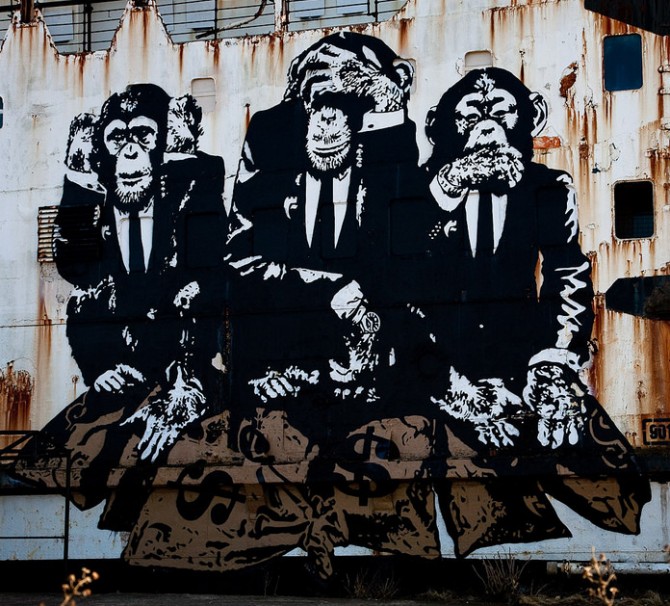
And that’s totally cool; stories genuinely do have value. Some are more enduring than others. Some have genuine, real-world utility. But it all rests on a shared fiction in the heads of a species of upright ape.
On a practical level, what it means is that, as investors, we want narratives that will both endure and that can affect increasing real-world value creation. In particular, narratives that are instantiated within a framework that itself can endure and grow. Faith in the story will ebb and flow, but if we can get the general direction right, we’ll be able to swap our ownership in one imaginary thing (a company) for another made-up thing (money), which will let us acquire the actual physical stuff we need to satisfy our material wants.
It’s a trip, man.
Strawman is Australia’s premier online investment club.
Members share research & recommendations on ASX-listed stocks by managing Virtual Portfolios and building Company Reports. By ranking content according to performance and community endorsement, Strawman provides accountable and peer-reviewed investment insights.
Disclaimer– Strawman is not a broker and you cannot purchase shares through the platform. All trades on Strawman use play money and are intended only as a tool to gain experience and have fun. No content on Strawman should be considered an inducement to buy or sell real world financial securities, and you should seek professional advice before making any investment decisions.
© 2026 Strawman Pty Ltd. All rights reserved.