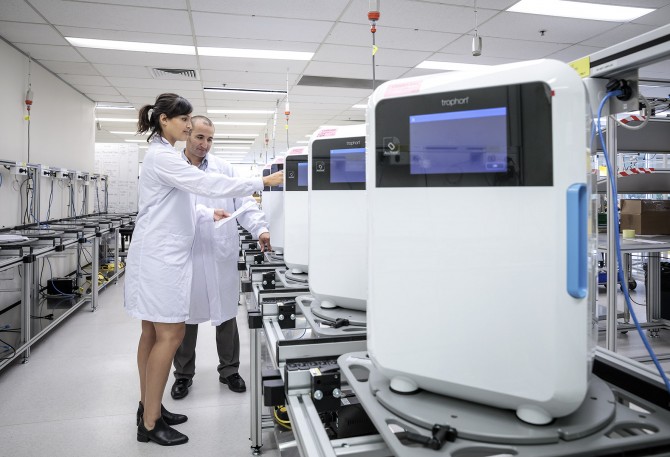
A business is best thought of as a machine; one that takes various inputs (capital, commodities, people) and converts them into outputs (products/services).
If you are interested in a company’s potential for growth, it helps to understand exactly how those inputs are converted to outputs. Furthermore, you need a sense of how demand for those outputs will change over time, and how effectively the business can adapt to that demand.
At the end of the day, from the perspective of an outside investor, all that matters is whether the company’s machinery is, or soon will be, self-sustaining. If the business is not viable without the need for regular injections of fresh capital, and the course is not corrected, all your capital will eventually be consumed.
More importantly, you want a machine that can multiply its inputs with increasing efficiency into ever-greater outputs. Find that, and you have effectively found a compounding machine that will, over time, provide you with far greater capital than you ever put in.
You can spend a lifetime honing your analytical skills toward this end, and that is a very worthwhile pursuit. But there is an easy first step you can take to determine how effective a company’s machinery has been in the past.
While history guarantees nothing about the future, it tends to be true that winners keep winning. A company with a demonstrated track record of effective capital multiplication tends to possess a durable competitive advantage, skilled management, or both. It also tends to represent lower risk, as its capability has at least been demonstrated previously.
In his 1984 annual shareholder letter, Warren Buffett gave us what has since become known as the “$1 test.” It seeks to measure how effective a company has been at multiplying the profit it chooses to reinvest rather than pay out as dividends.
In his words:
“Unrestricted earnings should be retained only when there is a reasonable prospect – backed preferably by historical evidence or, when appropriate, by a thoughtful analysis of the future – that for every dollar retained by the corporation, at least one dollar of market value will be created for owners. This will happen only if the capital retained produces incremental earnings equal to, or above, those generally available to investors.”
Essentially, a business should only retain the free cash flow it generates if it can reliably generate a higher rate of return on that capital than what could easily be achieved elsewhere. Otherwise, the only rational course of action is to pay out all free cash flows as dividends.
As a starting step, you simply need to compare the total retained earnings over a meaningful period against the change in market value. You want to see that for every $1 retained, more than $1 of shareholder value was created.
Let’s look at Fortescue Metals (ASX:FMG). Between financial years 2020 and 2025, the business generated $14.15 per share in earnings, of which it paid out $10.51 in dividends. At the same time, shares increased by 16%, or $2.31 per share. At first glance that doesn’t seem terrible, but given the company retained $3.64 in per-share earnings and only grew the share price by $2.31, we can see that it has failed Buffett’s test.
Actually, it is worse than that. As per the logic in Buffett’s test, you have to account for the opportunity cost of what shareholders could have done with all that unrestricted cash. If you assume a cost of capital of 10% per annum (which is not unreasonable given that is roughly the long-term average total return of the market) you need to see the incremental gain in share price at least equal to what the retained earnings would look like, in aggregate, if each dollar grew at that nominated cost of capital.
In the case of Fortescue, we should hope that the $3.64 in retained earnings helped boost the share price by at least $4.51, which is the total value if each year’s retained earnings were compounded at 10% per annum over the period. It is not just about a positive return on retained earnings, but a positive return relative to a reasonable cost of capital. That is what really matters.
Of course, this is somewhat simplistic as not all retained earnings are earmarked for growth, and accounting nuances like non-cash costs can obscure the picture. Furthermore, we are assuming that the change in market price over the period in question accurately reflects the change in intrinsic value — an assumption that is less likely to be true the shorter the time span you measure.
However, as a rough and ready test, it does a good job of highlighting which companies have the most efficient machines for capital multiplication. Those with a history of efficient internal compounding are very much worthy of your attention.
Strawman is Australia’s premier online investment club.
Members share research & recommendations on ASX-listed stocks by managing Virtual Portfolios and building Company Reports. By ranking content according to performance and community endorsement, Strawman provides accountable and peer-reviewed investment insights.
Disclaimer– Strawman is not a broker and you cannot purchase shares through the platform. All trades on Strawman use play money and are intended only as a tool to gain experience and have fun. No content on Strawman should be considered an inducement to buy or sell real world financial securities, and you should seek professional advice before making any investment decisions.
© 2025 Strawman Pty Ltd. All rights reserved.