I recently watched a talk by Patrick Honohan, Ireland’s central bank governor through the depths of the GFC. He was reflecting on the country’s property and banking collapse of 2009, and no surprise, it got my inner perma-bear twitching.
But this isn’t about to turn into some Chicken Little rant about the similarities with Australia’s housing market. Actually, there are important differences.
No, what really struck me about the talk was how the dominant narratives evolved as the crisis unfolded, and how they helped shape the response. And, mostly, how wrong they all were. Honohan laid out four narratives:
“We all partied.”
This was a government minister’s line that the crash was a collective hangover. Everyone was supposedly reckless, so everyone had to share the pain.
Except most people weren’t at the party. The dance floor was heaving with bankers, developers and overzealous investors, while ordinary people were just trying to buy a home, raise a family, and get on with actual productive things in the real (non-financial) world.
“Collateral damage.”
This was the idea that Ireland was an innocent who just got swept up by a wider global financial storm. Lehman Brothers fell, markets froze, and poor little Ireland was collateral damage. Except its banks were not victims — they were some of the most aggressive lenders in the world.
A major bank, Anglo Irish, was expanding assets at 36 percent a year. Per year!
“Bad, but manageable.”
This one came from Honohan himself. When he took over in 2009, he thought the crisis was severe but containable. In hindsight, he admits, it was wildly naive.
What’s crazy to me is that the authorities themselves didn’t even know the true scale of the hole they were in. There were banks providing 105% mortgages, lending standards were non-existent, and no one bothered to check the true exposure of the banks.
In the end, property prices would drop 60% and unemployment would reach 15%.
“Blame the ECB.”
The final story was to pin it all on the ECB. And to be fair, there was some truth to it. Brussels blocked Ireland from forcing losses onto bondholders, even on debts that weren’t guaranteed. Instead, the Irish government was pushed into making everyone whole.
When Ireland’s finance minister floated the idea of letting some of those investors take a hit, the ECB reportedly warned it would be like “a bomb going off in Dublin.” (Hardly the most sensitive choice of words given the country’s history.)
But if there was a bomb, and it had already gone off. Tens of thousands of mortgages sank underwater. Jobs vanished. Taxes rose. Public services were slashed.
Fortunately, the bankers were personally just fine.
Holding the can.
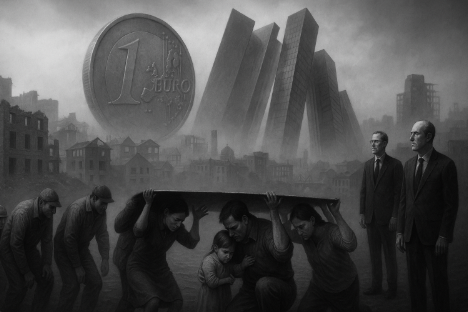
As always, it’s the poor and middle class that are left to pick up the tab.
In promising to back every liability of its banks, bonds included, the Irish government (read: Irish people) made €440 billion worth of guarantees. Ireland’s GDP at the time was €180 billion.
Of course, it was sold as necessary to prevent financial Armageddon. And there is some truth to that, given banks are essentially the payment network on which the entire economy runs. Only very small businesses can run on cash.
But it’s a half-truth. Payment services and customer deposits may justify a bailout. The other toxic stuff created by the banks… not so much.
The losses were simply socialised, with those least responsible for the calamity hit hardest by the forced austerity.
The takeaway.
Like I said, none of this is to try and draw any analogy with modern Australia (although you can draw a few if you want). Or to linger on the tragedy.
What’s fascinating isn’t the mistakes, it’s how wrong the narratives were, and how widely they were believed. Confidently presented, not entirely implausible, backed by experts and authorities. And mostly wrong.
You see the same thing in all big financial mishaps. It just takes a bit of distance and quiet reflection to realise there’s usually an Emperor’s New Clothes quality to much of the commentary. And the biggest misconceptions are often the ones everyone seems blind to.
For investors, that’s the challenge. The consensus is probably right most of the time, but when it’s wrong it can be spectacularly so. Unless you’re some financial savant, Michael Burry type, these moments are going to be hard to spot. (There’s a fine line between the kind of person who can call big turning points and the broken clock that’s occasionally right.)
For my part, I try to be alert but not alarmed. To understand the risks and handicap them. To balance them against the upside. To know what I own and why I own it.
And hope that those making the really big decisions are doing the same.
Strawman is Australia’s premier online investment club.
Members share research & recommendations on ASX-listed stocks by managing Virtual Portfolios and building Company Reports. By ranking content according to performance and community endorsement, Strawman provides accountable and peer-reviewed investment insights.
Disclaimer– Strawman is not a broker and you cannot purchase shares through the platform. All trades on Strawman use play money and are intended only as a tool to gain experience and have fun. No content on Strawman should be considered an inducement to buy or sell real world financial securities, and you should seek professional advice before making any investment decisions.
© 2025 Strawman Pty Ltd. All rights reserved.