Danile Tillet (CEO) and Peter Smith (executive chair) of Race Oncology (ASX:RAC) hosted a webinar update after hours on Wednesday of last week.
ASX:RAC - Race Anticancer MOA Webinar
In the webinar they explained the anti-cancer method of action of Bisantrene EE, which was all very interesting if in parts very technical and beyond my understanding.
However in summary and in RAC’s own words:
"The discovery of the primary anticancer mechanism of action of RCDS1 provides several benefits. Knowing how an anticancer drug works at the molecular level makes it much simpler to identify the cancer types (or sub-types) that are most likely to respond to the drug. This knowledge extends to aiding the identification of drug combinations that are likely to be synergistic when used together. Regulators prefer the MOA of new drugs to be included in regulatory submissions since it improves patient safety by helping predict side effects, guides appropriate use, and identifies the patients most likely to benefit. An important additional benefit to knowing the MOA of RCDS1 is it enables the development of pharmacodynamic biomarker tests that are predictive of a patient’s response to treatment. New cancer drugs with an associated biomarker test are more than twice as likely to obtain regulatory approval. Finally, understanding the MOA of a drug increases the probability of successful pharma partnering – put simply, large pharma has an expectation that their partners understand how any new drug works because this reduces scientific and clinical risk, improves trial design, and aligns with regulatory expectations.”
Both Daniel and Peter throughout the webinar were like the cat who had licked the cream, as you might expect given how far they have come.
So what have RAC got:
- An “old” cancer drug Bisantrene that has proven efficacy and was always interesting because of its cardio protection properties.
- Bisantrene has been reformulated as RC220 to remove the old problems with crystallising in the human vein
- A successful Phase 2 result using Bistantrere in combination with decitabine to treat Acute Myeloid Leukemia. RAC claims it is Phase 3 ready for AML.
- RAC have worked out Bisantrene has isomers and have isolated the active and light sensitive (EE) version. Potentially this will give a 20 year patent life to Bisantrene EE. A big deal.
- RAC claim to have worked out the method of action of the drug.
- Current phase 1 trials on solid tumours in combination with doxorubicin are ongoing. Initial safety readouts have been positive.
All valuable, particularly at points 4 and 5 above. Just how valuable who knows. The (likely overexcited) market is currently giving RAC a value of around $800m.
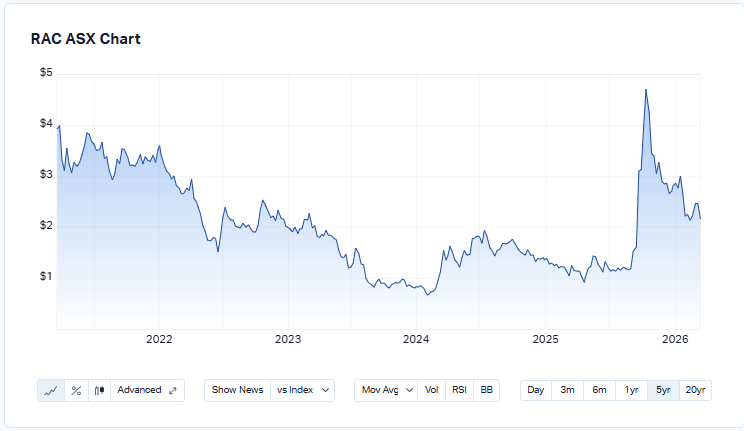
In the next two weeks RAC will be releasing more information on the cardio protection mechanism and will be meeting Hong Kong shareholders next week. Around 3 years ago when it was becoming obvious Neuron was onto something John Pilcher engaged Jeffries (I think) to advise the company. What he as announcing was he was frightened NEU would get taken out prematurely. Who knows who has been doing all the buying in the last 6 weeks that has seen the RAC share price triple. However with Daniel owning 10% and the recent share price run up maybe Daniel does not feel as vulnerable as NEU once did.
Perhaps better buying market opportunities this week as another chapter in the China/US war plays out. When the market does inevitably get the heebies a biotech speculative like RAC will likely be wacked pretty hard. And the problem will be, it will be hard to buy it when there are attractive companies that are earners and less risky that will also be discounted. Because everything about markets is a story of relative values.