From a largely agrarian third-world country, impoverished under a brutal communist regime, China has grown to be the world’s second-largest economy in just a few short generations. (Actually, it already claimed that title in 2016 if you measure things in purchasing power parity instead of GDP, which arguably, you should).
Since the turn of the century, GDP has grown from US$1.2 trillion to nearly US$18 trillion today, at an eye-watering annualised compound growth rate of close to 12%, at least according to official figures. In the process, it birthed a multitude of corporate giants like Alibaba, Tencent, and Huawei.
As an investor, you could have hitched your wagon to the VanEck FTSE China A50 ETF (ASX:CETF), which gives exposure to the 50 biggest listed Chinese companies. But had you done so a decade ago, you would have received an average annual return of 2.4%. In real terms (the only terms that matter), you actually made a loss.
It doesn’t seem possible, but those are the facts.
Perhaps the Global Robotics and Artificial Intelligence ETF (ASX:RBTZ) would have been a better bet. This grants exposure to names like Nvidia and ABB Ltd, which have done rather well, but had you bought this ETF at its inception about five years ago, you’d have likewise achieved a rather disappointing return: about 2.3% pa, on average, each year.
Okay, maybe ESG is more your vibe. That was the flavour of the day not too long ago, but had you sought exposure via the Australian Sustainability Leaders ETF (ASX:FAIR), you’d actually have lost money even in nominal terms.
I’m being a bit selective here, but the point is that you can be generally right on the broader trajectory of a country, sector, or theme and still do rather poorly as an investor.
There are a few reasons why this happens. First off, a lot of these ETFs launch or gain popularity right when the hype is hitting its peak, so by the time you’re buying in, all that “future success” is already baked into the price.
There’s also the “fat tail” problem. Even if a specific industry is booming, most of the individual companies in that space will still end up being duds (how many of the listed internet stocks from the late 90s still survive today?). When you buy an ETF, you’re getting the winners, sure, but you’re also dragging along a long list of losers that brings your whole average down.
“Diworseification” is a real thing.
And sometimes an ETF just suffers from good old-fashioned bad management. Actively managed ETFs, just like their unlisted forebears, are only as good as the high-paid geniuses running them.
But by far the biggest reason is that there’s a world of difference between a “growing” sector, as defined by increasing aggregate revenues, and a sector that produces positive returns on capital for investors. Activity and associated revenues can soar, but so too can costs. What matters for investors is the return per unit of invested capital, per unit of time.
Look at the rise of wind energy in the UK, which after massive investment has the largest offshore wind generation capacity in the world. It’s a laudable goal, and there are sensible non-economic reasons to pursue it. But as an investor in that space, you would have been fleeced. Although turnover in the sector reached approximately £77 billion in 2024, up over 90% since 2015, the returns are essentially non-existent — something investors in the Greencoat UK Wind Trust (FTSE:UKW) know all too well.
Remember, ETF providers create products based purely on whether they perceive a sufficient demand. It has nothing to do with how good the investment might be. As the saying goes: when the ducks quack, you feed ‘em!
The point is that you need a lot more than a compelling narrative to do well. If the underlying businesses can’t provide good returns on capital, you are relying on sentiment alone…and that is a very brittle footing on which to stand.
Don’t get me wrong, I think ETFs are mostly a good thing, especially those that offer low-cost exposure to broad market indices. As the father of ETFs, John Bogle, said: instead of trying to find a needle in the haystack, just buy the haystack. It’s good advice.
Even the more specific ones have their place, provided you realise they push you much further up the risk curve than the marketing suggests.
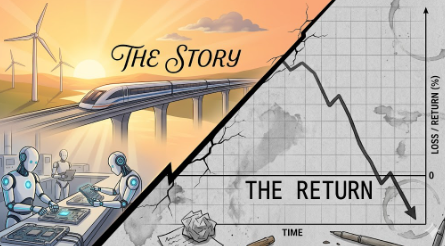
Just don’t make the mistake of confusing a compelling story with a profitable one.
Strawman is Australia’s premier online investment club.
Members share research & recommendations on ASX-listed stocks by managing Virtual Portfolios and building Company Reports. By ranking content according to performance and community endorsement, Strawman provides accountable and peer-reviewed investment insights.
Disclaimer– Strawman is not a broker and you cannot purchase shares through the platform. All trades on Strawman use play money and are intended only as a tool to gain experience and have fun. No content on Strawman should be considered an inducement to buy or sell real world financial securities, and you should seek professional advice before making any investment decisions.
© 2026 Strawman Pty Ltd. All rights reserved.