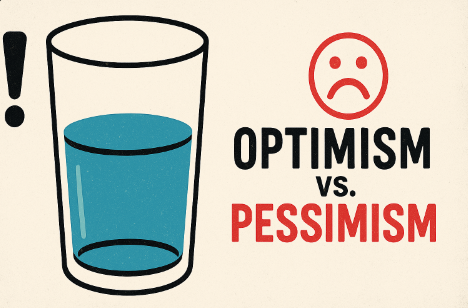
Strawman member Bushmanpat kicked off an interesting thread this week, pointing out how pessimistic takes tend to dominate headlines, while optimistic ones are often ignored. Inspired by a piece in the AFR, it was a good reminder of the persistent bias in both media and markets: we are hard-wired to give more attention and credibility to bad news.
Our tendency to be drawn toward doom likely stems from a bias first identified by Kahneman and Tversky — losses hurt us roughly twice as much as equivalent gains reward us. When survival is at stake, as it was for most of our evolution, that instinct makes perfect sense. But in the modern setting of financial markets, it tends to be more of a hindrance than a help.
Another big factor is that negativity tends to sound more intelligent. It feels more prudent and thoughtful. Positivity, by contrast, often comes across as naïve or unaware. As Harvard’s Teresa Amabile once said, “Only pessimism sounds profound. Optimism sounds superficial.”
But sounding smart and being smart are two very different things.
More importantly for investors, habitual negativity is often expensive, especially in terms of opportunity cost. It encourages inaction, blinds us to upside, and leads to consistently missed gains.
Like a broken clock, the permabears are right occasionally, and they get to dine out on their clairvoyance for years whenever their concerns are seemingly validated. But predicting nine of the last two crashes is hardly impressive.
As Peter Lynch pointed out, far more money has been lost by investors preparing for corrections, or trying to anticipate them, than has been lost in the corrections themselves.
History shows that markets tend to climb a wall of worry. Despite all the calamities of the past century — wars, recessions, pandemics — markets have generally trended higher over time. Not in a straight line, but in a messy, persistent kind of way.
The current environment is a good case in point. It’s hard to recall a more bearish bull-market, yet here we are, effectively at record highs despite facing significant geopolitical, social and economic challenges.
That’s not to say we should always see the glass as half full. Sometimes pessimism is warranted, because facts, reason, and experience demand it. Blind optimism can lead you into all kinds of bad investments.
And we should also distinguish between the market as a whole and individual stocks. The broader market can reasonably be expected to rise over the long term, but most listed businesses underperform the average, and many go to zero. For stock pickers, that changes the calculus somewhat.
This is where the distinction between skepticism and cynicism becomes essential. Skepticism questions claims and tests assumptions. Cynicism assumes the worst by default.
As Morgan Housel puts it: “Being skeptical is healthy; being cynical is lazy.”
So how do you strike the right balance? There’s no formula, but a few principles help:
Recognise the media’s incentives
News outlets want clicks. Fear and outrage grab attention. A negative headline often reflects what drives engagement, not what reflects reality.
Zoom out
Even great businesses have setbacks. But there’s a big difference between structural problems and temporary speed bumps. If you bail at every wobble, you’ll miss out on those long-term compounding multi-baggers.
Look for specificity
Cynicism often hides behind vague, sweeping fears. As Housel puts it: “Optimism demands facts and is ditched at the first sign of trouble. Pessimism can be grown from a crazy thought and clutched indefinitely.”
Be more wary of grand narratives about collapse than of detailed, evidence-based critiques.
Separate probabilities from headlines
Just because something can go wrong doesn’t mean it will — and even when it does, the impact is often smaller or shorter-lived than expected. In fact, widely shared concerns are usually priced in, and sometimes even create attractive entry points.
Be humble about what you know
Uncertainty is part of the game. There’s no such thing as a sure thing. But you don’t have to force an investment. The old saying holds true: “If in doubt, leave it out.” There are always enough opportunities to focus only on what you understand well and believe in.
Default to cautious optimism
Optimism isn’t about blind faith. It’s a belief that problems tend to get solved, value gets created, and thoughtful builders are rewarded over time.
Bottom Line
Pessimism is seductive. It sounds smart, responsible, even moral. But unless it’s grounded in specific, well-reasoned analysis, it’s often just theatre dressed up as insight.
Constructive optimism, tempered by skepticism and guided by evidence, isn’t just a better mindset for investors. It’s a more profitable one.
Strawman is Australia’s premier online investment club.
Members share research & recommendations on ASX-listed stocks by managing Virtual Portfolios and building Company Reports. By ranking content according to performance and community endorsement, Strawman provides accountable and peer-reviewed investment insights.
Disclaimer– Strawman is not a broker and you cannot purchase shares through the platform. All trades on Strawman use play money and are intended only as a tool to gain experience and have fun. No content on Strawman should be considered an inducement to buy or sell real world financial securities, and you should seek professional advice before making any investment decisions.
© 2025 Strawman Pty Ltd. All rights reserved.