Company Report
Last edited 2 months ago
PerformanceCommunity EngagementCommunity Endorsement
ranked
#3
Performance (91m)
17.6% pa
Followed by
1398
Straws
Sort by:
Recent
Content is delayed by one month. Upgrade your membership to unlock all content. Click for membership options.
#Accounting issues
Added 2 months ago

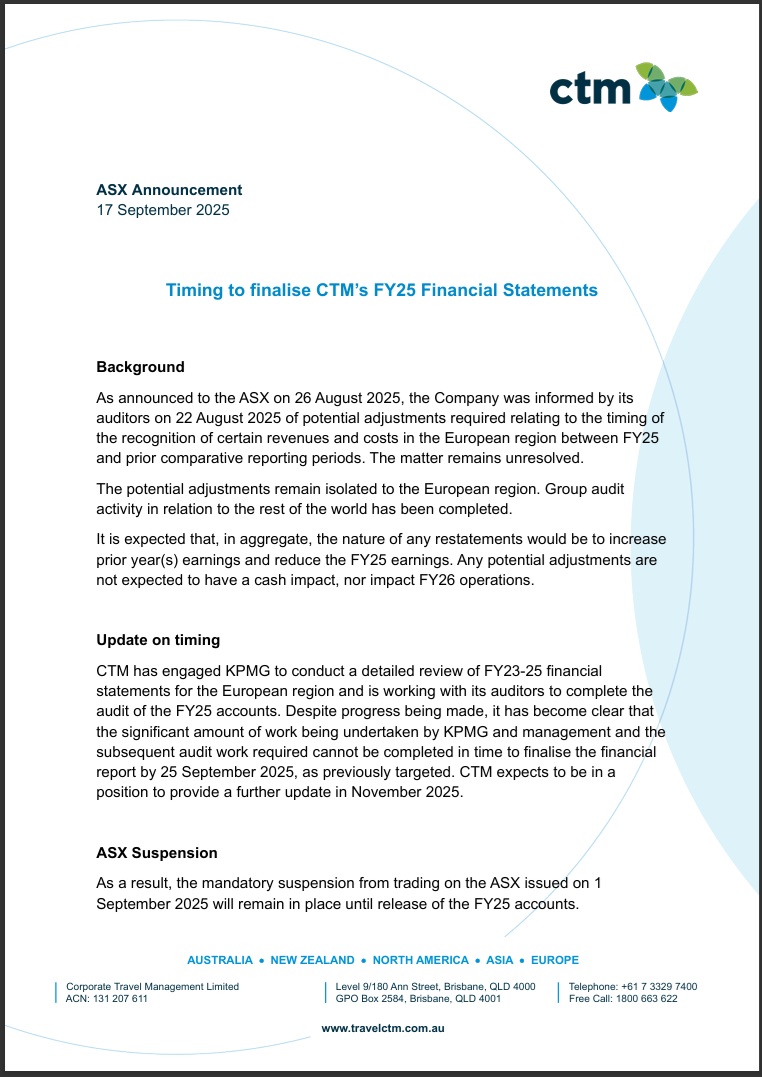
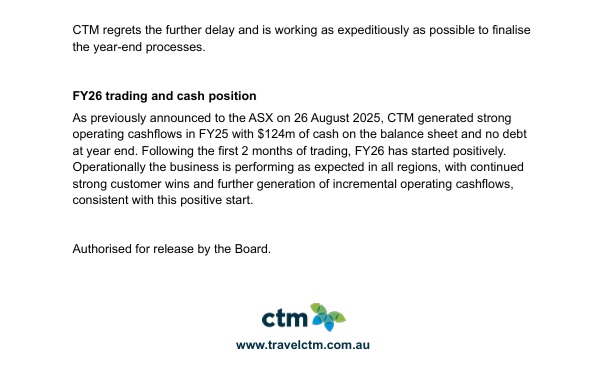
17th September 2025: Timing-to-finalise-CTM-FY25-Financial-Statements.PDF
deb9963992010098b22aecca85eb4acc7dc3ee.jpeg

1b332940f7d77d683cd031184551d0e293a5db.jpeg

Source: Timing-to-finalise-CTM-FY25-Financial-Statements.PDF [17th September 2025]

See also:

Opinion: Could the long fight over Corporate Travel be reaching its denouement?

Jamie Pherous has been battling short-selling hedge funds for most of his life, as chief executive of the business travel specialist. Now his stock is suspended.

Jonathan Shapiro, Senior reporter, AFR, Aug 31, 2025 – 8.49am

When the shares of Corporate Travel were placed in a trading halt around lunchtime on Friday, August 22, it seemed as though the moment of vindication for the company’s legion of sceptics had arrived.

Jamie Pherous, founder of the ASX-listed company and a former accountant, floated the travel agency in 2010. And for the first five years, he enjoyed the status of a celebrated founder. But for the past decade, he’s been at war with short sellers and cynics, who have continuously questioned his bookkeeping and the share price that has been guided by the numbers he presents.
1dc58d1edf85a3b04594f8176b9a468dab395c.png

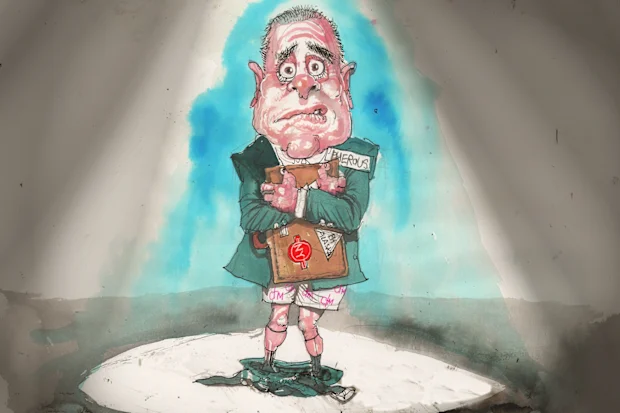
Corporate Travel Management founder and managing director Jamie Pherous. The boss’ war with short sellers went nuclear on a sleepy Sunday in October 2018, when hedge fund VGI Partners alleged aggressive accounting and poor disclosure.  [image: David Rowe]


So when the Friday lunchtime announcement revealed a dispute with its auditor Deloitte that would delay the release of its full-year accounts and lead to material corrections, hearts began racing on all sides. Was this long-running market stoush finally reaching a definitive resolution?

Since that day, Corporate Travel’s ASX updates have suggested that any potential fallout from the auditors’ concerns may be less significant than feared – relating to a quibble about jurisdictional revenue recognition.

The outcome is that previous years’ profits will have to be adjusted upwards at the expense of this year’s profit, the company has since said. But we won’t find out exactly what the issue is for some time.

That creates an unusually long stand-off in a war that saw its opening salvo fired way back in November 2016, at the first Sohn Hearts & Minds investment conference. In the final session of the day, Perpetual portfolio manager Anthony Aboud told the audience why he was shorting the travel agency after its share price had increased 18-fold since its 2010 listing.
88bba4d9cecfc43062ae1bcc9d17f419c57c63.png

Corporate Travel, Aboud explained, was a classic roll-up play, using its high market valuation to buy the earnings of other businesses that in turn are revalued at the higher value, lifting the share price. The company’s growth therefore relied on continuously buying other businesses.

“The PE magic only works for so long,” Aboud said at the time.

The war with short sellers went nuclear on a sleepy Sunday in October 2018, when VGI Partners dropped a 178-page presentation that alleged aggressive accounting, poor disclosure and phantom locations.

The rare activist campaign divided the market and left scars on all sides as Pherous countered the hedge fund’s claims.

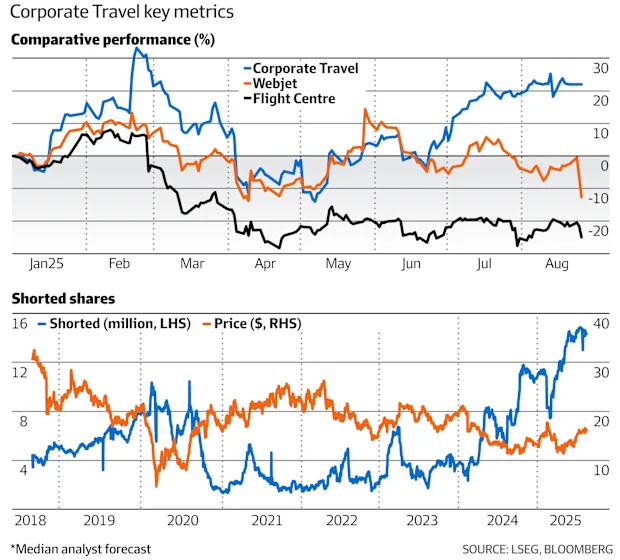
Fending off short sellers was arguably easier than dealing with the existential threat of a global pandemic in 2020 that completely shut down all forms of travel. While the likes of Flight Centre and Webjet were forced to raise hundreds of millions of dollars to survive the lockdowns, Pherous miraculously avoided an emergency capital raise. The bespoke travel needs of governments and businesses meant higher-margin contracts, and both the business and its share price proved resilient.
8e94246cd5e93c609b35f963a53261cdbbb9a2.png

Pherous also used the global shutdown to make deals, flying to Omaha in September 2020 at the height of the global lockdown to ink the $274 million acquisition of Travel & Transport.

If ever there was a moment to declare victory, it was in the post-pandemic glow, with Corporate Travel’s shares topping $25 in April 2022.

But despite all the clear air, Corporate Travel has failed to entirely rid itself of cynics. The company and its enigmatic founder have left the market as divided as ever.

Questions about its accounts have lingered, and short sellers have refused to go away. Among the most divisive issues are the company’s confusing disclosures about the materiality of its United Kingdom asylum seeker contracts, and a highly unusual share transfer to former executive Laura Ruffles.

The accounts have also got short sellers trying to work out exactly what game Corporate Travel is playing. Why did they really abandon reporting total transaction volumes in 2023? And what explains the big swings in profit and margin from its European business over the past five years?

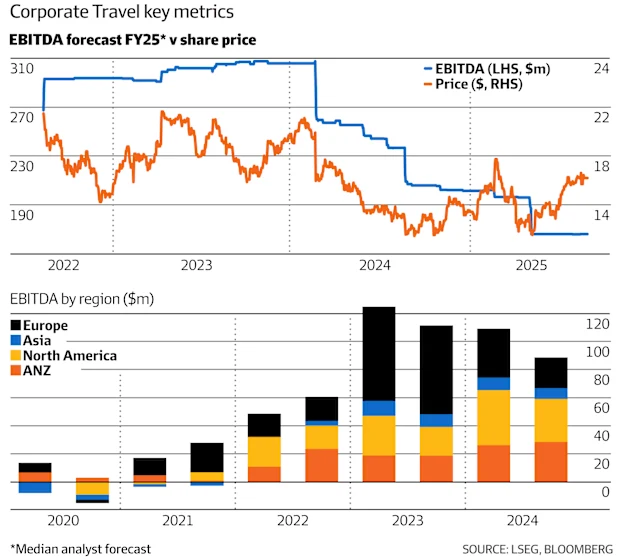
There also appears to be a hole in Corporate Travel’s earnings. The company has made two major acquisitions in the past five years, with little increase in profit. Two years ago, analysts had expected earnings in the 12 months to June 30 this year to come in at $300 million. Last year, that was revised to $250 million, and this year, consensus was closer to $160 million.

According to some brokers, cash and accounting profits matched each other for a decade – until 2022. That’s when the relationship broke down, ultimately creating a gap that has now stretched to $200 million.

Corporate Travel naturally sees things differently. A spokesperson said the two acquisitions – Travel & Transport and Helloworld’s corporate unit, purchased for $175 million in April 2022 – are contributing to earnings in its non-European division. This part of the business, the company says, is growing its earnings at a healthy clip, and will continue to do so.

Corporate Travel says it is also converting revenue and profit into cash. Its cash conversion target – between 80 per cent and 90 per cent of operational profit – is being met, as evidenced by its $124 million cash balance.

To explain the profit swings in Europe, Corporate Travel pointed to previous statements that the business had been in a state of transition while lucrative war-related travel projects came to an end. It was also winning new customers at a record rate, it said, and the current year had started well.

“In the absence of FY26 guidance until we report, the May 2, 2025 commentary states the new customer wins will be a positive contributor at group and Europe regional level in FY26,” the spokesperson said.

The new customer wins, along with reports from global airlines that activity was picking up, lured buyers to Corporate Travel’s stock heading into reporting season.

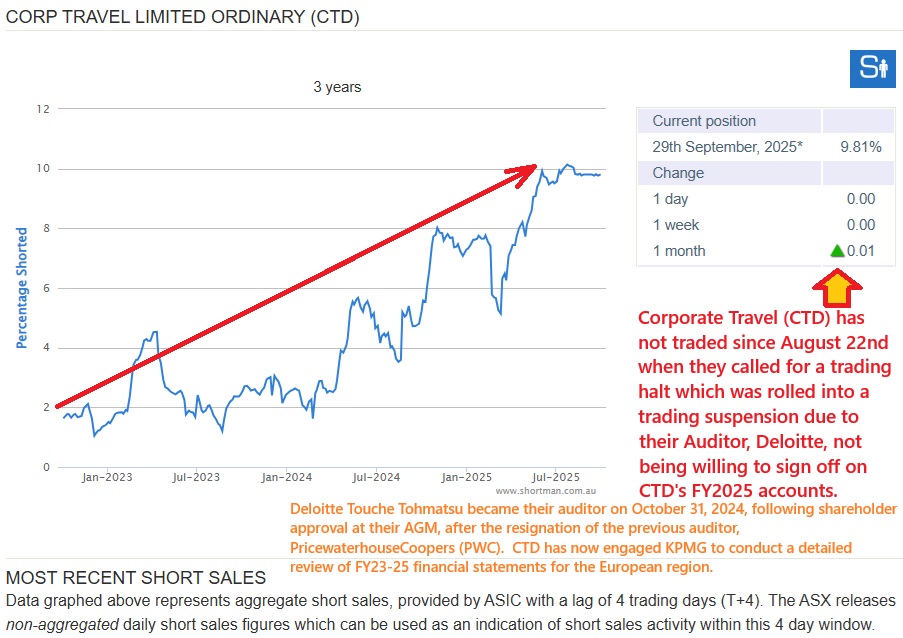
Short interest also edged higher. More than 10 per cent of the share register had been loaned out to hedge funds, a four-fold increase since the start of the year. This put Corporate Travel among the 10 most shorted stocks on the local sharemarket by mid-August.

Then came the trading halt.

The company had recently switched auditors, replacing PwC with Deloitte. Corporate Travel has since hired KPMG as a third party to help resolve the accounting issue, which relates to the timing of revenue recognition.

It’s not the first time an ASX-listed travel agency has found itself in a dispute with Deloitte. And there are some complex accounting rules regarding whether to book revenues at the time of ticketing or the time of travel, which some say may hold the key to understanding Corporate Travel’s bookkeeping mysteries.

Word is that the situation is resolvable. The consequence would be that earnings from prior years increase, but the current year’s decrease. The changes were non-cash-related, and an update like that would seriously reduce the stress levels of fund managers holding the stock.

But the lengthy delay does complicate life for them, at least in theory. Will they value Corporate Travel at the last traded price of $16.07 for any investors seeking to subscribe, or to redeem their funds, or will they apply a discount?

We’ll have to wait until Corporate Travel get its books in order to know the current earnings capacity of the business, and the premium or the discount that the market applies to the stock.

But there is a bigger, lingering question. Will we be able to declare a winner in the long-running war between Corporate Travel and its sceptics? That’s unlikely: Jamie Pherous’ power to divide the market remains as strong as ever.

--- ends ---

Source: https://www.afr.com/markets/equity-markets/could-the-long-fight-over-corporate-travel-be-reaching-its-denouement-20250827-p5mq51 [31st August 2025]

1fc207853b44d2cd5ca6350044e25107db4f48.jpeg

Data sourced from: https://www.shortman.com.au/stock?q=CTD


The shorters are not always wrong.


Discl: Not held.

#Media
stale
Added 6 years ago

23-March-2020:  AFR:  Rear Window (Joe Aston):  Corporate Travel has enough money... today

There can be no surer sign that a company will soon need to raise equity than when it issues a statement to the ASX saying it has “no current need to raise equity”.

Corporate Travel Management volunteered this status update on Thursday just hours after peer Webjet tried and failed to raise emergency capital – always an impossibility for a company generating net zero revenue (that goes for both companies).

Corporate Travel’s board of directors, led by Ewen Crouch (hastily departed from the Westpac board’s risk and compliance committee), insisted its “liquidity position remains strong”, so strong it postponed a $19.6 million interim dividend that had already gone ex!

“CTM is in a net cash position which means its operating cash exceeds its drawn debt, as at today. CTM has a committed debt facility of $250 million…”

The biggest red flag here is that Corporate Travel refuses to simply say how much cash it’s got, which means not very much. Riddles like these are Jamie Pherous’ speciality, but not terribly consoling for investors during a massive market slide.

Note the qualification “at today”, a conspicuously narrow point in time for the disclosure. Lucky they don’t need any emergency cash because “at today” is not an assurance that any equity capital markets banker could get very far with.

Will it have that much cash “at tomorrow”? Or “at month’s end”? Of course not. And any enterprise can amass a quick cash pile by leaving bills unpaid.

So on one day last week, Corporate Travel had enough cash to cover the balance of its primary loan, but has virtually zero incoming revenue while staring at an absolute mountain of refunds. All good then!

That same evening, the company’s house broker Morgans had a note out to its clients – the same clients it has been force-feeding this stock all the way up and over $30 a share. Analyst Belinda “Buy” Moore downgraded her price target another 25.7 per cent from $10.21 to $7.59, which was still 31 per cent north of Friday’s closing price. [meaning Friday 20th March 2020]

Moore has dutifully followed the company’s shares, from a safe distance, down their rabbit hole, downgrading to $19.40 on February 17 (closing price: $16.11), to $18.45 on February 19 (closing price: $15.97), then 44.7 per cent to $10.21 on March 13 (closing price: $9.25). Her valuation should hit 15¢ per share the same afternoon it goes to zero.

Call that a buffer? Compared to her, Morgan Stanley’s gun analyst James Bales is skiing without poles, persisting with his $27 per share valuation on Thursday with Corporate Travel closing at $4.70. Bales is something of a visionary, expecting 474 per cent upside from a travel agency while the borders are closed.

--- ends ---

07-May-2020: AFR (Vesna Poljak): Corporate Travel wins waiver of loan covenants for 2020

Corporate Travel Management's debt facility has been reduced by £25 million ($48 million) to £100 million, and the travel group has secured a waiver of covenants linked to the 2020 calendar year, averting a scenario that could have triggered its loans being called.

Managing director Jamie Pherous told the annual Macquarie Australia Conference on Thursday that "we have a significant portion of clients that are still travelling despite no travel". Those customers are overwhelmingly in government, healthcare, mining and critical infrastructure utilising charter flights and hotels because they are unable to get commercial flights.

"We don't suffer those negative cashflow issues that the retail industry is having," he said.

Corporate Travel rescinded earnings guidance in March but declined to update the market on what it might earn in 2019-20 on Thursday. For the month of March, its preliminary estimate of underlying EBITDA (earnings before interest, tax, depreciation and amortisation) was a loss of $3.2 million.

As part of its new loan terms, which still mature in August 2022, the company's covenants will be tested only against the January to June period of 2021 for the 2020-21 financial year.

"In that sense, we've got a $200 million facility, $30 million net cash as of today, we're burning at the lower end of the $5 million to $10 million [a month] range," Mr Pherous said.

"The good part is we can get a low break-even and return to profitability with a modest domestic recovery because the vast majority of those revenues will fall straight through to the bottom line."

However, his cost base will increase under a full recovery scenario. "But again we would manage that carefully," Mr Pherous said. Corporate Travel's interim dividend has already been deferred until October.

"We haven't got April numbers yet but we expect it to be around the lower end of that $5 [million] to $10 [million] moving forward."  The stock closed at $12.08, up 8¢, and down 41.1 per cent for the year to date. [07-May-2020]

Suppliers being fair

Corporate Travel has declined to raise capital during the pandemic, whereas Flight Centre has raised $700 million and Webjet – on its second attempt – raised $346 million.

"I'm sure that some people won't survive this," Mr Pherous said of the travel industry and forthcoming acquisition opportunities.

In terms of bad debts, it has provisioned for about $10 million. The failure of Virgin Australia represents the largest exposure within that but no more than $3 million to $5 million in total. Mr Pherous said he was comfortable with that.

"Suppliers are being really fair and saying, 'we'll just agree to a fixed remuneration to get through this and we'll talk about other things at a later point'."

Mr Pherous declined to speculate on when normality returns but said he was guided by China. He was specifically encouraged by the governments of Australia and New Zealand indicating they could form a cross-border travel bubble, and potentially also in Asia where China, Hong Kong, Macau and Taiwan could be another bubble.

"People are itching to get back and travel."

--- ends ---

Further Reading:

https://www.afr.com/rear-window/vgi-confirmed-as-hockey-s-mystery-hedge-fund-client-20200422-p54m58

Disclosure:  I do not hold any shares in CTD, FLT or WEB.  Wish I'd bought some QAN at around $2 in March though...


#Market Updates
stale
Last edited 6 years ago

07-May-2020:  Covenant Waiver and Market Update

Covenant waiver on existing facility

Corporate Travel Management (CTM, ASX:CTD) is pleased to announce that it remains in a strong liquidity position and has reached agreement with its existing banking group to waive all financial covenants for calendar year 2020.

The following key terms have been agreed:

  • Waiver of all financial covenants for CY2020 including the removal of COVID-19 from MAE definition
  • Covenant testing for the period ending 30 June 2021 to be based on 2H21 performance
  • Total facility £100 million (circa AUD200 million) reduced by £25 million from £125 million
  • Facility term maturity remains August 2022

Managing Director Jamie Pherous said, “We are pleased with the continued support of our banking group and the outcome that we have achieved.  As at today, we are in a net cash position of approximately $30 million (net of client cash) and when combined with the revised banking facility terms and low cash burn, we remain in a strong liquidity position and are well placed to rebound once travel resumes.” 

Market Update:  Macquarie Australia Conference Presentation 

The announcement [link above] also contains a market update presentation that Managing Director Jamie Pherous presented today at the Macquarie Australia Conference.

It ends with the following Summary:

  • Strong liquidity position. $30m net cash @7 May with committed facility of approx. AUD$200m
  • Relatively low monthly cash burn of $5-10m/month. Currently at the lower end of cash burn range
  • Resilient business model that is highly flexible, capital light and can ramp up/down quickly as required
  • Positioned for domestic recovery. Can return to profitability with a modest recovery in domestic travel
  • Investing in our technology platforms and feedback loops to deliver new solutions as required
  • Total client base has increased throughout the Covid-19 period.  The number of clients has increased through new client wins, retentions and extensions of contracts.

--- click on the link at the top of this straw for more of this announcement - including the full presentation ---