
Top member reports
Company Report
Last edited 2 months ago
PerformanceCommunity EngagementCommunity Endorsement
ranked
#1
Performance (98m)
22.2% pa
Followed by
2588
Straws
Sort by:
Recent
Content is delayed by one month. Upgrade your membership to unlock all content. Click for membership options.
#CEO Meeting
Added 2 months ago

The recording for today's chat is now live on the Meetings page and you can interrogate the transcript here:

DBI Transcript October 2025.pdf

As mentioned, DBI strikes me as a low risk affair -- Provided, that is, they retain balance sheet and CAPEX discipline.

Here's a condensed summary of the risks from AI, which I asked to review the transcript:
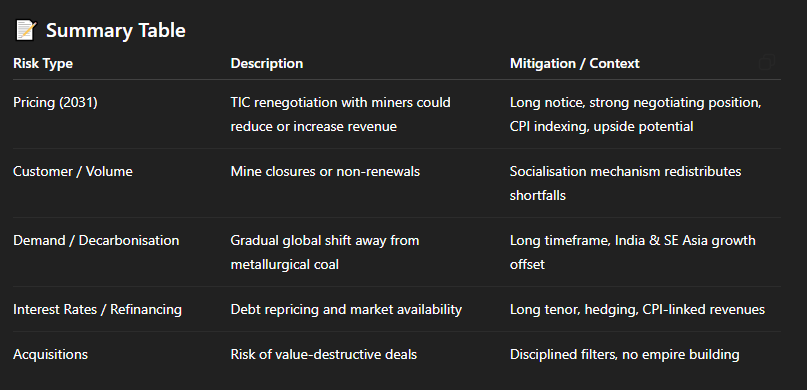
18df35df5324804d3c80240f8703ea173955ad.png


Coal is undoubtedly a sunset industry, but it’s a very long sunset. The transition will take decades to play out, and metallurgical coal is likely to be the last segment to decline. Electric arc furnaces are part of that shift, but smelters typically don’t upgrade until their existing blast furnaces reach the end of their useful lives (often 30-40 years). In the meantime, countries like India are expected to prioritise the lower-cost, traditional (and dirtier) blast furnace route to support their rapid steelmaking expansion.

A 5.6% yield, (roughly 60% franked), with the dividend expected to grow between 3-7%pa sums to a very tidy return (*if* that's what they are able to deliver). Plus, if you like your divvies, they pay distributions quarterly.

#CEO Meeting
Added 9 months ago

Dalrymple Bay Infrastructure is a bit different from the usual companies we discuss — not just in size ($1.8 billion market cap) but in how it makes money.

The value prop here is all about stable cash flows and dividends. In fact, at the current price, and based on what Michael said, you can expect a forward yield of about 6%, of which 2/3rds franked (so a gross yield of ~7.6%). Paid quarterly, too.

You can watch the full recording on our meetings page, but here are some key highlights from our conversation with CEO Michael Riches:

  • DBI’s biggest selling point is the predictability of its cash flow. The company owns Dalrymple Bay Terminal (DBT), which exports metallurgical coal used in steelmaking.
  • It’s a regulated infrastructure business, meaning:
  • 84.2 million tonnes of contracted capacity, locked in until at least 2028.
  • Take-or-pay contracts ensure DBI gets paid regardless of how much coal actually ships.
  • No direct exposure to commodity prices. miners take the risk, DBI just collects fees.
  • No weather risk -- even if a cyclone shuts the terminal, DBI still gets paid.
  • Of course, longer-term, the business is still tied to metallurgical coal demand, and in turn global economic activity, but it is sheltered from much of this in the medium term.
  • Also, its revenue is inflation-linked which might be interesting to those that have concerns on that front.
  • $394 million in capital projects (NECAP, or non expansionary capex) means higher future fees, as there is a set return linked to this expenditure.
  • The 8X expansion project could increase capacity, but it’s still uncertain and dependent on miner demand.
  • DBI has $1.8 billion in debt, which is actually manageable given the asset backing and mandated cash flows, but refinancing at higher interest rates could impact profitability longer term.
  • While DBI exports to China, Japan, and South Korea, Michael stressed that geopolitical tensions and trade disputes have had little impact on terminal operations.
  • Even during China’s 2020-2023 ban on Australian coal, miners simply redirected shipments to other markets, demonstrating the flexibility of global demand. Still, it's something to be mindful of.
  • Michael also pointed out that tariffs and policy changes in export markets have not significantly affected DBI’s customers. Since steelmakers need high-quality metallurgical coal, they have few viable alternatives, meaning demand has remained strong across various markets.
  • DBI operates under a regulated pricing framework until 2031, providing clear earnings visibility for the next several years. But after 2031, pricing will be renegotiated with customers, although Michael believes any future agreements will continue to support strong cash flows.
  • While metallurgical coal is essential for steelmaking, some miners are exploring lower-carbon alternatives. However, Michael was confident that demand for high-quality Australian coal will remain strong for decades, given the lack of commercially viable alternatives at scale.