


ERD out with a very poor update today, compounded by the fluff headline "EROAD strengthening focus on ANZ opportunities".
Why is ERD focusing on Australia and New Zealand? Because the US segment which came about from a large acquisition in 2021 continues to be a struggle, with a large customer churning to a competitor and sparking a write-down of ~$150m.
The US has been challenging for some time and a return to strong growth was not part of my original investment thesis. ERD's top line has been modest growth for some time, but management had done well to rationalise the cost base which had resulted in what I thought was a sustainable cash profit base to build from:

ERD management is now guiding to $197-203m revenue for FY26, below the previous $205m forecast but still ahead of FY25's $194.4m. In FY25 ERD achieved a 12% free cash flow margin before the cost of a 4G upgrade cycle, and are now guiding to 5-8% for FY26.
It appears as if ERD management's cost discipline which had served them so well to returning the business to cash profitability was discarded to chase higher growth and as @Strawman wrote recently a management team chasing growth is often the fastest way to destroy shareholder value.
There may be light at the end of the tunnel for shareholders as the Co-CEO overlooking the US segment has now been pushed out of the business and perhaps some cost discipline will return.
Disclosure: Merewether Capital Inception Fund exited it's ERD position today.
Despite ERD generating modest revenue growth in recent years, it has been achieved in the face of a tough operating environment for their core enterprise logistics customers. Trade disruptions, fuel costs, insurance premiums and labour shortages are all contributing as headwinds to transport companies and brings risk to ERD’s new customer growth and existing customer churn.
Another key risk is a challenging US segment where growth has stalled in the last twelve months:

Some of this slowing growth comes from a strategic decision to focus on larger enterprise customers in the US and allow small/medium customers to churn away. However, the majority of US customers came from the acquisition of Coretex in 2021 (which saw the large spike in hardware units seen above) and the integration of the Coretex business and customers has not gone smoothly.
However, I believe these risks are more than compensated in the current price, and they are potentially offset by the promise of the nascent Australian segment. Australia lost $2.9 operating profit in FY25, but revenue grew 28% and the segment is quickly scaling towards profitability and will soon be a contributor to overall group.
Lazy copy and paste from latest Merewether Capital report (https://www.merewethercapital.com.au/wp-content/uploads/2025/06/MC-May-25-Report.pdf)
ERD is a provider of enterprise fleet telematics solutions, beginning life in New Zealand with a hardware product focused on regulatory compliance for Road User Charges. While still enabled by hardware, ERD has broadened its software solutions to capture driver safety, Chain of Responsibility obligations, fleet operating productivity and asset maintenance.
With a full-service enterprise fleet software platform, ERD generates 95% of its revenue from software as a service subscriptions which has steadily grown over time (benefiting from a large acquisition in FY22):
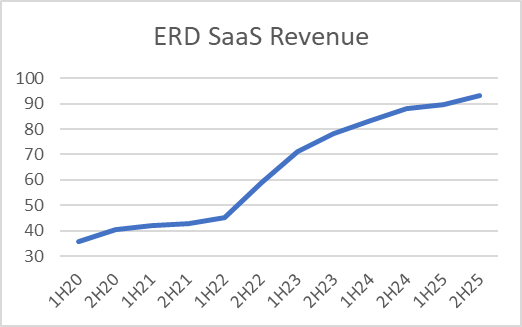
Despite solid revenue growth over the last five years, the share price has not reciprocated, falling to a low of 40c in 2023 after peaking above $5 back in 2021.
It’s a story familiar to many tech stocks through 2022/23 as the market’s appetite for companies to burn cash to chase higher growth rates quickly dissolved. ERD lost $48m in FY22 and $35m in FY23 and with a dwindling share price and weak balance sheet the company was forced into a highly dilutionary capital raise at 70c in 2023 (made even worse by the Board knocking back a takeover bid a few months prior for $1.30!).
Like peers who suffered similar fates, ERD made the tough decision to move on key executives including CEO/Founder Steve Newman, with the new executive team committing to a cost base rationalisation to move the business back to generating cash flow again.
ERD capitalises some expenses such as software development and customer acquisition costs which can make the operating cost base in the profit and loss statement a bit misleading, but looking purely at the cash being spent each year it is clear to see how the cost base rationalisation has played out over the last few years:
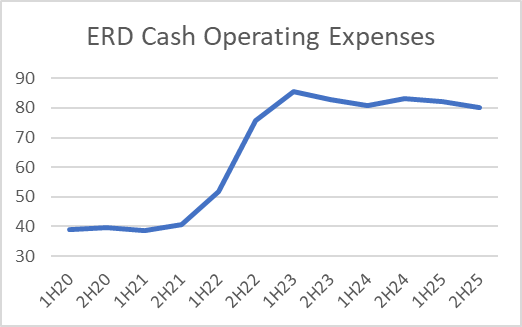
Steadily growing revenue and a flat cost base has led to the key thing we look for in an investment; the jaws of operating leverage opening and more of each incremental dollar of revenue falling to the bottom line:
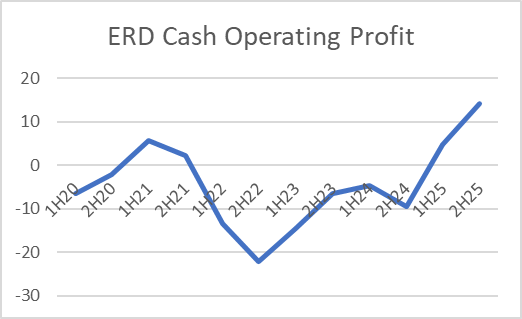
Impressively, the rapid inflection in cash operating profit shown above has been achieved despite the significant headwind of ERD needing to embark on a large capital expenditure program to replace ageing 2G and 3G hardware units in Australia and New Zealand as telcos shut down their legacy networks.
ERD has spent $17m over the last two years as part of the upgrade program, with a final $13-15m to be spent before December 2025 when the final network is planned to shut down. The finalisation of the 4G upgrade program will not only provide a further tailwind for cash profit growth but will also free up ERD’s internal resources to shift focus back to new customer growth.
At a current enterprise valuation of ~$295m, ERD trades on just over 1.7x annualised recurring revenue and 15x cash operating profit (11x when adjusted for the 4G upgrade program) which is a very cheap valuation for a high margin (75-80% gross margin), recurring revenue (95% subscription revenue) business that has now inflected to cash profitability.
With management committing to growing cash profitability with a continued focus on cost discipline I expect the market to begin to see the value in ERD given a growing cash profitability has been the catalyst for significant re-rates in several ASX technology businesses in recent years such as Gentrack, Bravura, Energy One and Catapult.