


Price History
Premium Content
Premium Content
Premium Content
$ARX FY26 — A breakout year: the OviTex overhang is now explicit, and Myriad is firmly the key growth driver
Pre-amble
Aroa Biosurgery released their FY26 result this morning. Preliminary results were foreshadowed 4 weeks ago, and for those interested in further background I refer you to recent posts by @mushroompanda
Market response has been subdued in part due to the earlier release, but also what might be considered soft guidance and management indicating a significant step-up in US sales and marketing resourcing. I’ll address both.
@Strawman has arranged a further meeting with CEO Brian Ward, next Wednesday, so today’s results are a good set up for that meeting.
Headline numbers were strong and exceeded guidance on both lines, but the story is increasingly bifurcating between the directly-sold Myriad franchise (firing) and the partner-distributed OviTex line (structurally constrained, for reasons that got what I consider as an honest airing on the call). Symphony sits separately as a newly de-risked potential upside – not yet recognised by the market, not unreasonably given that management have yet to prove they can capture the opportunity presented by the disruption unfolding in the synthetic skin outpatient market, which Brian discussed in some detail on the call.
TLDR
FY26 represents a long-awaited breakthrough into profitability (cash and NPAT); however, the market clearly doesn’t believe an inflection point has been reached. Will reinvestment into US sales and marketing see a continuation of the operating leverage of recent years, where costs have been managed carefully? The norm for ASX-listed medical devices cracking the US is that this can be a hard slog. Or, are management being conservative in the guidance given, such that stronger-than-guided sales momentum more that offsets the expanding sales and marketing cost base?
FY26 vs FY25 — the headline numbers

The trend in key financial metrics is clear in the graph below.

Source: My analysis of Company accounts – numbers differ from management “adjusted” figures.
On a constant-currency basis, revenue of NZ$101.3m beat the top of the NZ$92–100m guide, and normalised EBITDA of NZ$11.3m came in at ~174% of the guidance midpoint of NZ$5–8m.
Direct sales are now 59% of product revenue (up from ~52% in FY25) and growing materially faster than the partner channel. $ARX’s destiny is increasingly in its own hands, a turnaround from a previous thesis breaker for me.
Operational highlights in the year include:
- Customer accounts grew to ~440 (from ~330) on a broadly flat sales headcount of ~49 reps — that's the operating leverage management have been pointing to, in numbers
- Symphony's randomised control trial (RCT) in DFUs met its primary endpoint (announced earlier, confirmed today, with further details to come on publication of the trial)
- GPO contracts secured across all major groups, covering >95% of US hospitals, but $ARX’s limited sales force footprint meaning that only a minority of these are being accessed today
- US tariff costs of NZ$1.6m absorbed cleanly; a contingent ~NZ$1.4m refund identified but not recognised (potential FY27 tailwind – good luck, join the queue!)
- Five consecutive years of revenue growth; Myriad alone has compounded from NZ$4m (FY22) to NZ$49m (FY26)
Key Drivers
Myriad has been the story for several halves now, and it remains so. +54% on a base that was itself +39% the year prior, sold by ARX's own reps into the hospital OR, with reported gross margins north of 90%. Trauma and limb salvage are the bread and butter.
Brian was explicit on the call when Matt Joass asked whether anything one-off had boosted growth — no competitor recall, no regulatory windfall, just sales execution against a TAM management now sizes at US$750m+. (Note: I’m not convinced that Brian was right here. Primatrix (Integra) and Myriad do overlap, as pointed out previously by @mushroompanda, and there is no doubt in my mind that $ARX has been a beneficiary of the protracted absence of Primatrix – as have the many other competitors. This is something to watch in FY27, now that PriMatrix is back!)
$ARX has invested steadily over the years in building evidence to support its marketing claims. For example, the MASTRR registry continues to grow the evidence dataset across multiple surgeons, with the 423-patient interim analysis due in FY27 Q2.
Separately, the longer-dated COVER RCT is worth noting. Myriad vs Myriad + NPWT (negative pressure wound therapy). NPWT is used in >1m procedures per year in the US. If the combination beats NPWT alone, that's a genuinely large new wedge for Myriad. Not in FY27, but in the pipeline.
Endoform's -6% is deliberate — management has been candid that almost no effort has gone into it for ~4 years while resources concentrated on Myriad. That changes now, because Symphony plugs into the same Endoform legacy: hospital outpatient department, which is literally the floor below where the OR team already calls. (More on Symphony below.)
The OviTex situation: this deserves careful reading
Headline OviTex growth of 8% continues to be underwhelming, and $ARX is guiding flat OviTex sales to TELA Bio for FY27. More telling is what's buried in the audited financials: the TELA Bio revenue-share growth assumptions used to calculate accrued contract revenue have been slashed — OviTex from 19% to 2.7%, OviTex PRS from 37% to 15.8%. That's a meaningful de-risking of a contract asset that now sits at NZ$21.4m, and it tells you management's internal expectations for the OviTex line have stepped down materially. The audit report flagged this as a key audit matter.
Brian addressed it directly and (IMO) transparently. The substance:
- TELA Bio has hospital contracting headwinds. Becton Dickinson is alleged to have locked up ~80% of the US hernia mesh market through long-term hospital contracts, effectively foreclosing OviTex from accounts on commercial rather than clinical grounds
- TELA Bio has now filed antitrust action against BD in the US District Court for the Eastern District of Pennsylvania (filed 19 December 2025), alleging exclusionary conduct, retaliatory contracting against providers using OviTex, and abuse of dominance (BD reportedly holds ~65% of permanent and ~77% of resorbable hernia mesh spend in the US). BD's stated position is that the allegations are without merit
- In parallel, TELA Bio is pursuing a unique reimbursement code that could route around the contracting issue altogether
Brian's validation argument could be seen as compelling: in the UK, where BD doesn't have the same contract structure, OviTex sales are surging on clinical evidence alone. The product works — the issue is purely a distribution moat being defended by an incumbent with very deep pockets.
My read: the BD litigation is a multi-year process and outcomes are uncertain even on a successful path. The reimbursement-code workaround is potentially faster but unproven. I'm now treating OviTex as an effectively flat ~NZ$43m revenue line with potential upside, rather than a growth contributor. That's a material change to how I'd previously modelled it. If you'd previously assumed 15–20% OviTex CAGR (and many of us did, including management based on their prior accounting estimates), you should be re-cutting that now.
Symphony: has the catalyst just became real?
The Symphony RCT meeting its primary endpoint in DFUs is, I think, the most under-appreciated single element of this result. The setup:
- From January 2026, CMS reset reimbursement for skin substitutes to a flat-fee basis regardless of product price
- Brian's framing on the call: the addressable US market re-bases from ~US$10bn (inflated by perverse incentives that paid clinicians a percentage of product cost) down to a US$1–2bn 'real' market
- Many incumbents priced at thousands of dollars per application are now uneconomic. Brian noted competitors are already exiting and inventory dumping is occurring
- In the new world, winners need (i) RCT-grade evidence, (ii) competitive pricing, (iii) hospital outpatient access. Symphony has all three. Many competitors don't have RCT data because they didn't need it under the old reimbursement regime
It is worth noting on the trial design: $ARX used a meaningful proportion of Wagner 2 patients (more severe DFUs) alongside the standard Wagner 1 cohort that competitors typically restrict themselves to. If those subgroup results read out positively when published in Q2 FY27 (that’s the 3Q CY26!), it widens Symphony's clinical positioning further - evidence based differentiation.
FY27 guidance assumes Symphony contributes just NZ$1–5m, explicitly conservative per CFO James Agnew. The NZ$4m incremental sales infrastructure spend is to 'get a toehold' rather than chase a number. Clearly, the opportunity is unproven and management must be uncertain. However, this could emerge in the second half of FY27 as a significant upside, driving momentum into FY28. Another one to watch!
Operating leverage and the FY27 setup
The cleanest signal in this result is the leverage: revenue +23%, opex +11%, normalised EBITDA +201%. Management aren't going to let that compound through FY27,— they're explicitly stepping up sales and marketing investment by NZ$9m (NZ$5m for Myriad scaling, NZ$4m for the Symphony launch). EBITDA guidance of NZ$8–11m therefore implies a small absolute decline in EBITDA, despite 13–23% revenue growth. And this is why today’s SP response has been muted – the market was expecting more revenue growth and short term profit growth.
However, I think management is making the right call. The Myriad rep count has been deliberately held flat while productivity per rep was improved (now 440-odd accounts across 49 reps, vs ~330 accounts on a similar headcount in FY25). See the chart below.

Over FY24 to FY26, management has held the direct sales force essentially flat at c.50, while driving activation of new customer accounts from c.300 to c. 440, driving sales growth. By comparison, benchmarking this, Polynovo services 800+ US hospital accounts with a direct force of 85 + 15 management (based on my analysis of recent disclosures). So, for this market this size of ARX's sales force is underweight, reflecting a more cautious management approach.
FY27 will add 10–15 reps, and management has telegraphed a 100–120 rep target over 3–5 years. Based on looking across competitors, 100+ definitely makes sense to me, and this should drive continued strong sales growth over this timeframe.
What helps is that $ARX has a portfolio of products, and reps. can visit both the OR and the hospital outpatient clinic. Importantly, the salesforce will be enabled by a growing body of clinical data – both for Myriad, and now for Symphony – to breathe life into the withering Endoform franchise, and also take advantage of a disrupted outpatient environment with a low-cost product, compared with competition. It is a good set up albeit one with several moving parts.
The Symphony "reset window" is time-sensitive. If $ARX doesn't establish itself while competitors are exiting, the opportunity narrows materially. That said, don’t expect much from FY27 as the outpatient segment is in turmoil, with inventory to be offloaded presenting a short-term supply overhang.
Capex – still OK for the coming years
I asked management on the call about manufacturing capacity and future capex. Brian and CFO James both seemed comfortable. Existing facilities support NZ$200m+ revenue at current mix, with capex guidance of ~NZ$10m per additional NZ$100m of revenue capacity (potentially better at NZ$120–130m given the higher-mix products). That's a very capital-light scale profile and reinforces the self-funding narrative.
My Key Takeaways
1. The Myriad franchise is now at scale (NZ$49.5m, +54%, >90% GM, direct, durable evidence base) and on its own justifies a material share of the current market cap. Last five-year CAGR is ~65%.
2. OviTex needs to be re-marked to flat for the foreseeable future. The optionality from BD litigation and the unique reimbursement code is real but unquantifiable; I'd value it at zero in a base case and treat upside as gravy.
3. Symphony is the most interesting near-term catalyst and is conservatively guided. The CMS reset is a once-in-a-decade market dislocation in a re-based US$1–2bn market, and $ARX has the RCT evidence most competitors don't. (Look out for the details when published later this year!)
4. The FY27 EBITDA decline is intentional, not deteriorating fundamentals. But the operating-leverage narrative does pause for a year while management reinvest operating cash to build out the US sales force. And while that’s more “jam tomorrow” it is worth bearing this in mind given the muted market reaction to the result and the guidance.
5. Self-funding with NZ$27m of cash and no debt. Balance sheet is in good shape to execute. Financially sustainable.
Conclusion
On balance, $ARX is set-up to execute sustainably in the US, with multiple upsides from existing products. While I have held $ARX in the past, I exited (last in Dec-22) because I considered the path to cash generation just looked too long and the economics and reliance on Tela Bio both unattractive.
International expansion is a further upside. Management don't say much about this, but sales are no doubt via distirbutors in what is a competitive and well-served market. So resources would need to be allocated if this is to become material. An option perhaps, when the US potential has been captured - commendable focus by management.
Based on the FY26 result, and some of the insights provided, and the growing body of positive clinical evidence and Myriad traction, I’ve recently decided to give $ARX another chance. In fact, I’ve added to my position this morning, doubling it to 4.5% of my RL ASX portfolio.
Growth is now more in the hands of management as they have established their direct US sales force. They are much less dependent on Tela Bio (which remains a significant risk as it continues to burn cash.The last 5 years have seen the SP slide progressively from US$15 to US$0.90 today.)
The bull case has therefore narrowed somewhat. OviTex is no longer a core growth lever. However Myriad is scaling and Symphony offers upside. Genuine risk now sits on OviTex and, to management's credit, they’ve now been pretty clear about that.
I do believe there is a degree of conservatism in management’s guidance. Realising the upside does come down to how well they execute the sales and marketing expansion (under their control) plus whatever hopefully positive surprise Tela Bio can achieve.
Valuation
I'm still re-cutting my valuation following today's data. The key questions are: i) scenarios for Myriad, and ii) potential upsides for Symphony, with the cost base /capex now well-characterised.
To me, $ARX is looking like anything from $0.60 to as much as $1.20 – but for more than that, I need to crank the model. Picking up some more this morning at $0.62 and $0.64 seems pretty decent.
I’m really look forward to the Strawman meeting, and will be doing more work on $ARX in the lead-up to it.
Disc: Held (RL 4.5%)
Soft tissue generation company $ARX posted their 4C today.
While I don't hold $ARX, I follow its progress and performance as part of my general monitoring of the dermal repair sector, as I currently hold $AVH.
Their Highlights
• Operating cash flow was NZ$2.1 million.
• Strong cash receipts from customers of NZ$23.5 million. •
Total cash on hand increased by $1.3 million, ending the quarter with a cash balance of NZ$23.4 million.
• Positive net cash flow for fourth consecutive quarter.
• FY26 guidance reaffirmed - total revenue of NZ$92-100 million and normalised EBITDA of NZ$5-8 million.
• H1 FY26 results to be released on Tuesday 25 November 2025.
• Highest recorded sales quarter for Myriad™ of NZ$10.2 million.
• Eight new peer-reviewed studies published during the quarter.
• Proposed changes to US outpatient wound care reimbursement policy present an opportunity for AROA’s Symphony™ product.
My Assessment
Below I included my casf flow tracker, where the trend lines plotted are over the last 8 quarterly reports.
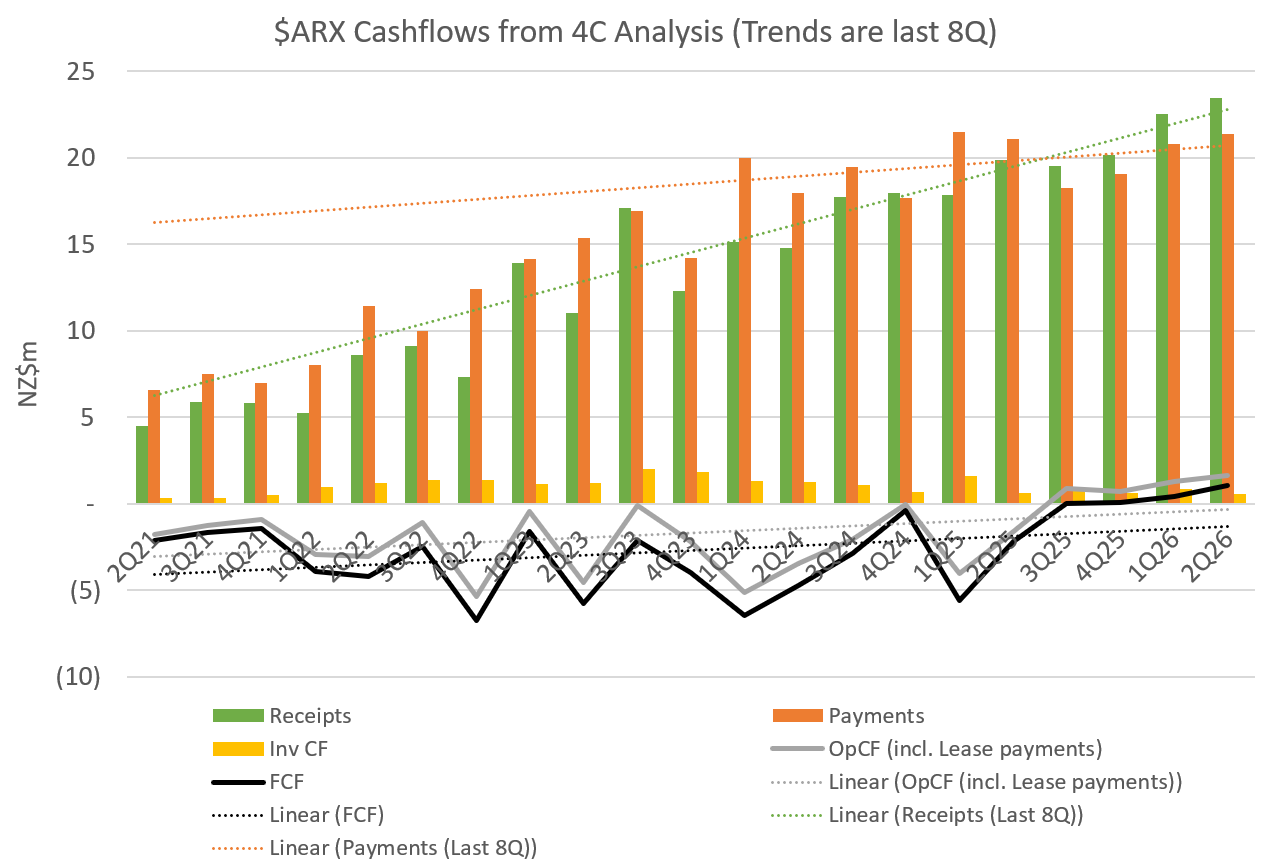
Today's report is the 4th consecutive report of positive operating and free cash flows - an important milestone for the business indicating that it has passed through the inflection point to cash profitability.
Receipts grew +18% to PCP, with costs being well controlled with payments up only 1.2%. For now, the existing facilities are able to absorb demand growth - so capex is low, and there have been no announcements of any impending, significant new capex (although at some stage this will be required).
Without getting into a lot of detail, the company appears to be making steady progress across the product portfolio. Importantly, the recent rate of sales growth is consistently outstripping the rate of cost growth, which bodes well for sustainable profit growth - albeit at an unspectacular level. FY26 appears on track to deliver a maiden positive NPAT. Guidance for Revenue and EBITDA for the FY were maintained.
My chips are still very much on $AVH (assuming they work through recent misfortunes which have been covered amply on this platform).
$ARX appear to be well-managed, with a product portfolio that continues to gain traction in the US market - growing above the overall rate of growth of the dermal substitutes market.
My takeaway from this result as regards $AVH, is that there are no discernible changes in the overall trends in the dermal repair segment. So $AVH's result will be judged very much on its own merits, with the big uncertainty as to whether the CMS coding problem with ReCell has been fixed, and the extent to which customer behaviour has "normalised".
Disc: Not Held
Dermal and wound repair company $ARX published their quarterly today.
Overall, incremental progress on all fronts. I don't hold (RL or SM) but continue to monitor as part of my focus on the sector, where I have a significant holding in $PNV.
Some lumpiness in results is driven by the restocking behaviour of their US Partner TELA Bio.
Improving (i.e. reducing) cash burn appears driven more by government grants and a lower rate of investment in new facilities than the product growth itself. (See bottom of post for my cash flow analysis.)
I have held previously, but won't because growth trajectory is modest compared with sector peers, and cash generation is not in sight. Overall revenue growth appears to be in the range 20-30%, having declined from 40-60% over FY22 and FY23.
What I do like about management is their level-headed and balanced reporting. For example, they could have highlighted that Q4 reciepts were up 46% to PCP, but they didn't because that would be cherry-picking a favourable prior period and lumpiness.
$ARX follows a Mar-Mar FY, so financials will follow in a few weeks.
Their Highlights
Financial Highlights
• Strong cash receipts from customers of NZ$18.0 million, reflecting a continuation of the prior quarter’s step-up in Myriad™ and OviTex™ /OviTex PRS sales.
• Positive net cash inflows from operations of NZ$0.3 million, exceeding Q4 breakeven expectations.
• Net cash outflows from investing activities reduced to NZ$0.7 million, reflecting continued planned investment into additional manufacturing plant & equipment capacity with completion expected by Q3 FY25.
• The Company achieved a 71% reduction in quarterly cash burn to ~NZ$1 million, ending the year with a strong closing cash balance of NZ$29.5 million.
Operational Highlights (My tuncated list)
• Continuing expansion in Myriad sales access during the quarter, with Myriad active accounts increasing from 205 to 218 during the quarter.
• Strong CY23 OviTex™ PRS and OviTex sales, with TELA Bio, Inc. (‘TELA Bio’) reporting CY23 revenue of US$58.5 million (41% ‘pcp’ 3 growth) and providing CY24 revenue guidance of US$74- 76 million (27-30% pcp growth).
• Product shipments to TELA Bio continue to re-align with its sales trajectory (following a reduction in shipments during H1 FY24) with H2 FY24 cash receipts from TELA Bio increasing 20% compared to H1 FY24.
• US launch of OviTex IHR, a new AROA ECM™ product specifically designed for use in laparoscopic & robotic-assisted inguinal hernia repair and co-developed with TELA Bio under the parties’ existing license arrangement.
• Enrolments completed for two clinical studies; the pilot study assessing Enivo™, AROA’s new tissue apposition platform technology, and the Myriad Augmented Soft Tissue Regeneration Registry (‘MASTRR’), AROA’s largest prospective study to date. AROA expects to commence publishing study results from Q3 FY25. AROA’s Symphony™ randomised control trial continues to progress well, with a total of 90 patients enrolled by the end of the quarter (n=120).
• A peer-reviewed publication of three case reports indicates that Myriad Matrix™ and Myriad Morcells™ may complement existing negative pressure wound therapy (‘NPWT’) protocols, reduce the frequency of dressing changes associated with NPWT usage in abdominal soft tissue defects and decrease the overall healing time of complex abdominal defects.
My Cash Flow Analysis
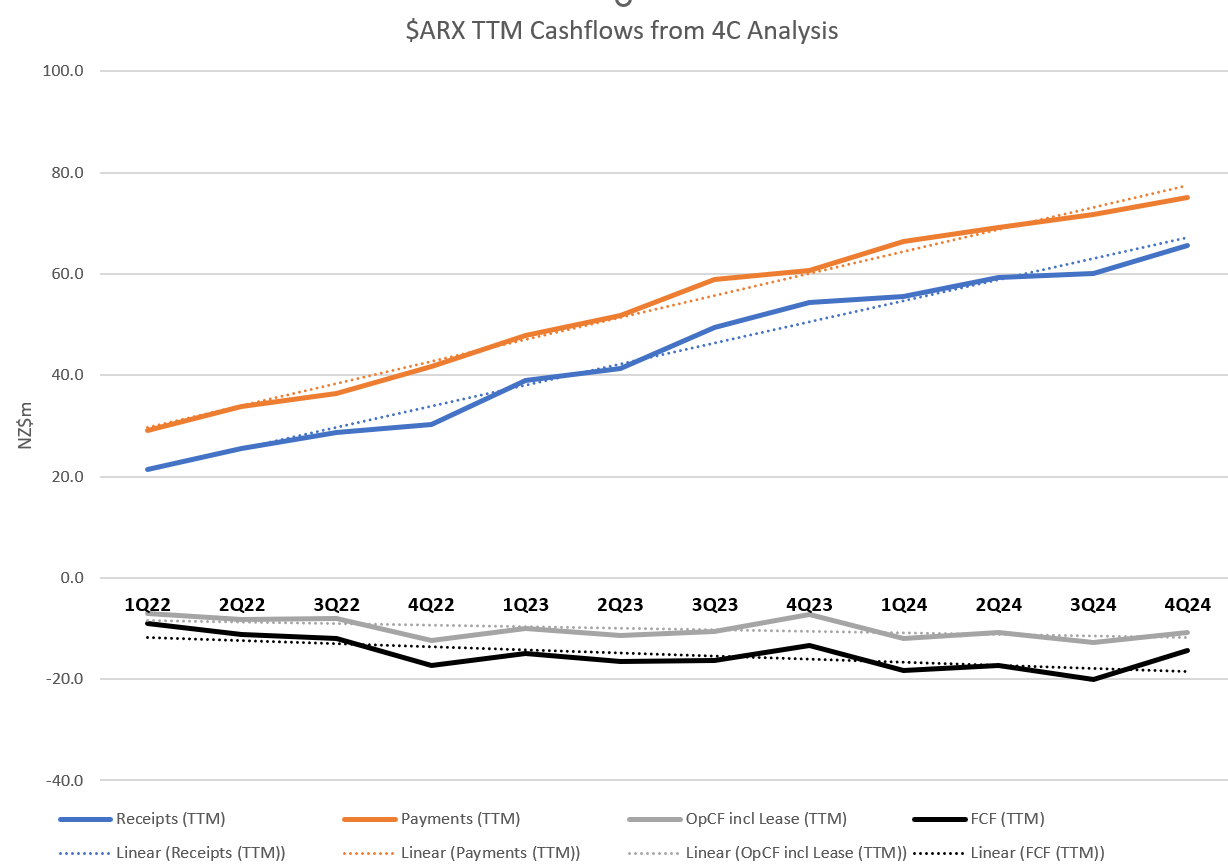
While there is a weak positive trend toward FCF generation emerging over the last 8Q, the improvement of the last 3-4 quarters is driven more by reducing investment and some government grants, than underlying strength in the operating economics. That said, the last year has seen improvements in cost control, while growth is continuing.
Quarterly view below in Fig 1, and TTM pic in Fig 2. On the quarterly plot, the trend line is last 8Q only.
Figure 1
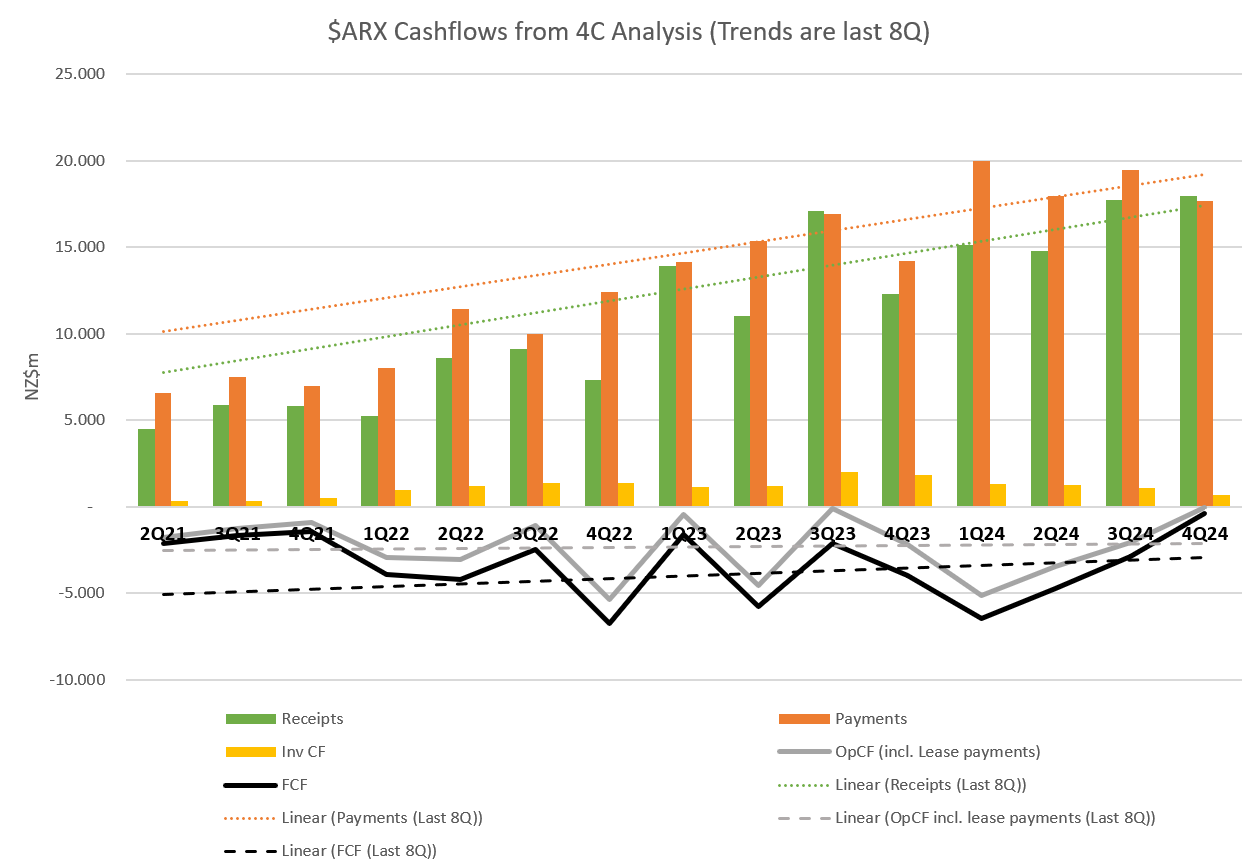
Fig 2
Disc: Not held
$ARX announced their 4C this morning.
While no longer a holder, because I have a significant holding in $PNV I continue to follow $ARX for insights on the other firms working in the dermal repair space. (Also $IART) But to clarify, for many indications these firms are not direct competitors, but they are playing in the same general space.
Their Highlights (I've selected only the more significant, as its a LONG list)
Financial Highlights
• Strong ~20% increase in quarter-on-quarter cash receipts from customers, to NZ$17.7 million.
• Continued quarter-on-quarter progress towards breakeven operational cashflows, with net cash outflows from operations decreasing to NZ$1.7 million from $3.2 million in the prior quarter.
• Net cash outflows from investing activities of NZ$1.1 million for the quarter, reflecting further investment into additional manufacturing plant & equipment capacity.
• Strong cash balance of NZ$30.5 million as at 31 December 2023, and the Company is debtfree.
Updated FY24 Full-Year Guidance
• Guidance reduced to NZ$67-70 million total revenue, NZ$66-69 million product revenue, 85% product gross margin and a normalised EBITDA1 loss of NZ$1-3 million.
• One-off (H2 FY24) decrease in expected revenue from TELA Bio, Inc. (‘TELA Bio’) due to a previous overestimation of AROA’s revenue share (non-cash) on inventory supplied to TELA Bio and a delay to a joint product development project. OviTex™3 and OviTex PRS remain on a strong growth trajectory.
• Robust Myriad™ sales performance, with 10% growth in Myriad active accounts from Q2 to Q3, comparable field sales productivity and a revised forecast of 70-85% year-on-year growth (full-year).
Operational Highlights
• US FDA (‘FDA’) 510(k) clearance received for a new product, a resorbable dental barrier developed and manufactured from the Company’s proprietary AROA ECM™ platform technology. The Company is actively pursuing a new partnership to commercialise this product.
• The FDA has reviewed AROA’s 510(k) application for Myriad Flow™, a new soft tissue regeneration product that could be commercialised in combination with Enivo™, and requested additional pre-clinical and clinical data to support a clearance. Both studies appear to be less complex than anticipated with regulatory clearances expected within 24 months.
• To date, six patients (n=10) enrolled in the pilot clinical study for Enivo, AROA’s new tissue apposition platform technology, have undergone a unilateral mastectomy and completed followup care, with no clinically relevant seroma or complications reported.
• 36 patients enrolled in AROA’s Myriad Augmented Soft Tissue Regeneration Registry (‘MASTRR’) during the quarter, taking the total number of participants to 268 (n=300).
•Enrolments in AROA’s multi-center Symphony™ randomised control trial approximately doubled during the quarter, with a total of 86 participants enrolled to date (n=120).
My Analysis
I'll keep it brief, with the cash flow trend analysis below telling its own story.
From my perspective, my thesis that this is not looking like an investible business is continuing to be supported with each quarter.
While you might think an 85% gross margin gives you a lot to play with on the expense side, the fact is that medical devices and pharma is a tough gig. The high costs of sales and marketing together with the ongoing and necessary burn of development expenditure quickly eats up the profit.
Despite the management key messages, there is no discernible trend towards operating or free cash generation. In 24 months we've seen cash shrink from $65m to $35m, with the last Q burning about $3.5m.
$ARX has some good technology, and they are using it to develop multiple platforms with many indications, evidenced by their continuing clinical program. However, the fact appears to be that none is making material headway into the ostensibly large addressible market.
Perhaps management are taking a longer term view? However, your view cannot be too long term. Competitor innovation means that products necessarily have a finite life cycle. At some point, you have to have a product that generates serious cash, and I can't see where this is coming from at $ARX. And if they continue to burn cash at the current rate, in about another 2 years time they'll be raising again. Its not an imminent issue, but with the trend it may be unavoidable unless something changes.
$ARX is playing in a competitive market. 20% top line annual growth won't cut it, and it highlights just how strong $PNV is with >90% GM and >60% topline growth now pushing $100m, enabled by a more focused product suite.
Disc: Not held in RL or SM

Kiwi dermal repair company $ARX issued its 4C report today. I didn't attend the call, but the report is very detailed. I haven't held $ARX for some time, but still follow it (along with $AVH and $IART) to better understand the space in which my core holding $PNV competes. As I said, the report is very detailed, so I am only reproducing their financial highlights, we there is nothing very standout operationally.
Their Financial Highlights
• Increased cash receipts from customers of NZ$15.2 million during the quarter, compared to receipts of NZ$12.3 million for the prior quarter.
• In line with expectations, net cash outflow from operations of NZ$4.8 million for the quarter, compared to the prior quarter outflow of NZ$1.9 million. This primarily reflected typical postfinancial year payments and a planned operating loss for the quarter. Net cash outflow from investing activities was NZ$1.3 million for the quarter, reflecting further investment into additional manufacturing plant & equipment capacity.
• Strong cash balance of NZ$38.5 million as at 30 June 2023.
• FY24 product revenue guidance maintained at NZ$72-75 million (25-30% increase on FY23 on a constant currency basis ).
• FY24 product gross margin guidance maintained at 85%.
• FY24 normalised EBITDA profit guidance maintained at NZ$1-2 million
My Analysis
Overall, there are no surprises that I can see from a quick read of the results - all aspects of guidance are maintained.
I have updated my usual CF analysis below, showing the last 8Q trends.

While receipts are on a clear uptrend, so are costs. In fact, both OpCF and FCF are on a slight negative trend.
With closing cash of NZ$38.5m, the balance sheet is strong. However, it is important to note that the since capital was last raised in 3Q22, over the 7 quarters since, the average cash burn has been NZ$3.8m per quarter.
Yet again there are reports about investment in expanding facilities. Evidence that these biologics are both more capital intensive and lower margin than synthetic BTM.
Of course Gross Margin is only one element. The release also provides some detail about the number of sales reps with sales greater than NZ$750,000 p.a. Interesting to note that DW and $PNV sets his sights on the higher A$1m for their top salesmen - a significantly stronger contribution margin. Just anecdotal, but interesting to me anyway.
My Key Take Aways
I took the decision to exit $ARX in June 2021 because of my clinical bias towards synthetics, the stronger growth rate of $PNV, and its higher margin. Over the last two years, while $ARX is sustaining top line growth, there is no sign of sustainable - let alone attractive - economics.
Bottom line, this looks like a good product with a growing number of indications, variants and clinical supporting evidence, but not a business.
According to Tradingview, the company is covered by 5 analysis with PTs ranging from A$1.325 - A$1.635, vs. todays A$0.90. It's on a much lower revenue multiple than its sector peers, however, with no trend towards favourable economics it probably deserves its current value and I don't understand where the 5 analysts are coming from.
With economics like this, it won't be bringing any pricing pressure to bear in its sector anytime soon. Which is good news for $PNV.
Disc: Not held
$ARX reported their 4C and due to their reporting cycle gave partial unaudited results for 1H23.
Their reported highlights:
Financial Highlights Q2 FY23
• Cash receipts of NZ$11.0 million received from customers during the quarter.
• Net cash flow outflow from operations of NZ$4.3 million for the quarter.
• Net cash outflow from investing activities was NZ$1.2 million for the quarter, reflecting AROA’s investment into additional manufacturing plant and equipment capacity.
• AROA ended the quarter with a strong cash balance of NZ$50.1 million as at 30 September 2022
Financial Highlights H1 FY23
• H1 FY23 product revenue (unaudited) grew 44% on H1 FY22 and 20% on H2 FY22 (on a constant currency1 basis) to NZ$28.8 million. H1 FY23 total revenue (unaudited), inclusive of project fees was NZ$29.3 million.
• H1 FY23 product gross margin (unaudited) was 84%.
• H1 FY23 Myriad™ product revenue (unaudited) grew 242% on H1 FY22 and 147% on H2 FY22 (on a constant currency basis) to NZ$5.6m million.
• H1 FY23 normalised2 EBITDA (unaudited) was positive.
Upgraded Guidance FY23
• Guidance upgraded to reflect AROA’s improved FY23 performance expectations including significant movement in the actual US$/NZ$ exchange rate.
• Total revenue guidance for FY23 of NZ$62-64 million (including NZ$2 million of project and license fees) on the revised constant currency basis (up 39-43% on FY22 on a constant currency basis). Previous product revenue guidance (on prior exchange rate) was NZ$51-55 million.
• FY23 guidance for product gross margin upgraded to 84% on the revised constant currency basis.
• FY23 normalised EBITDA expected to be approximately breakeven.
My Key takeaways
Overall, a weaker cash performance (see graph below), however, the Q-on-Q receipts tend to be very lumpy, so not reading too much into this one result. No concerns on liquidity given cash position, overall growth trend and strong %GM.
1H23 GM of 84% is a positive vs. FY22 of 76% and previous forecast FY23 of 77%. However, this is also an FX beneficiary.
Myriad accelerating its growth albeit off a low base.
Upgrade is a positive, however most of the headline impact is due to a FX impact (US$0.62=$NZ1 from US$0.70=$NZ1). Still, positive.
The operational report is largely positive, including a modest upgrade from partner Telebio.
Overall happy with this and expect a modest positive reponse.
Disc: Held in RL (1.3%) and SM (5.4%) - held mainly as an alternative ASX read on $PNV market

Aroa Biosurgery reported Quarterly Results today. In this straw I'll post first the company's own highlights and then some of my own reflections on the results following the very brief 15minute call this morning with the CEO and CFO. (Not many instos or fundies following this).
Top line summary: Good progress, no surprises either way. Need to keep an eye on margins. HOLD
Highlights
• Cash receipts of NZ$13.9 million from customers during the quarter.
• Net cash flow outflow from operations of only NZ$0.2 million for the quarter, down from NZ$5.1 million in the previous quarter.
• Net cash outflow from investing activities was NZ$1.1 million for the quarter, reflecting AROA’s investment into additional manufacturing plant & equipment capacity.
• AROA ended the quarter with a strong cash balance of NZ$55.4 million as at 30 June 2022.
• FY23 product revenue guidance maintained at NZ$51-55 million1 (up 30%-40% on a constant currency basis on FY22).
• Improving US sales performance with 95 Myriad™ active accounts at the end of Q1 FY23 (a 32% increase on the previous quarter) and two representatives with a current average run rate of over US$850,000 per annum.
• Progress is tracking well for AROA’s ENIVO™ range of dead space management products, with submission to the US Food & Drug Administration for the first product planned in December 2022.
• All participants in AROA’s Symphony™ pilot clinical study (n=10) have completed treatment. Work is underway to set up a randomized controlled trial evaluating Symphony in the treatment of 120 non-healing diabetic foot ulcers in the US.
• Progress is also tracking well on AROA’s Myriad Registry study, the Company’s largest prospective study with 48 patients enrolled to date.
My observations
Good results in line with guidance. Don't get excited about the step up in receipts and stepdown on cash outflow over the prior Q - this was flagged last quarter as due to a delay in key payments, which have been included in the quarter. A pity this was not quantifed - I should have asked!
Staff and corporate costs have increased quite sharply although there tends to be Q-o-Q noise around the growth trend. CEO said they are seeing some inflation, but they still expect to see margin expansion through this year due to sales mix tending towards a higher proportion of the higher margin MYRIAD product.
Steadily growing the US sales force, although expect to be behind their planned numbers. CEO said this was because they are focusing on salesforce productivity, but I sensed some awkwardness on this so I don't know if there is any underlying staff churn or recruiting challenges in a tight market - neither was mentioned.
Indicated they are pleased to be getting $850k sales from their top agents. (This is well behind $PNV and their saleforce is about 50% the size of PNV).
As shown in the 4C trend graph below over 8Qs, $ARX is not yet showing operating leverage, but the cash burn is low (FCF now -$1.3m compared with cash available of $55m). So there is time for revenue growth, margin expansion and sales force productivity to develop. I'm prepared to be patient.
Good updates on product development pipeline, publications and line extensions, all being managed at a constant investment cash flow of $1m to $1.5m per Q.
Overall, nothing exciting, Steady progress. I continue to hold a 1.2% portfolio position IRL. My major holding is $PNV.
To increase my position I'd want to see: a) revenue growth acceleration, b) margin expansion, c) operating leverage, d) continued positive news in development pipeline.
Valuation
I don't hold a valuation on ARX, but on a comparable basis of Market Cap to Sales, it is at a significant discount to $PNV (-42% when I last did the analysis).
EXHIBIT: Analysis of last 8 x 4C Cash Reports

Disc: Held in SM and IRL