Most technologies can be improved upon significantly after their initial invention. Steam engines, telephones, automobiles, and software all evolve through iterative refinement, with better versions replacing older ones. But every so often, something emerges that is fundamentally final in its category. Not because people stop innovating, but because the nature of the thing itself admits no superior version.
Algebra did not get replaced by “Algebra 2.0.” The internet did not need a successor protocol to TCP/IP. A hammer will always be a hammer. Once the world standardises on something that is both sufficiently good and fundamentally neutral, its network effects become unstoppable.
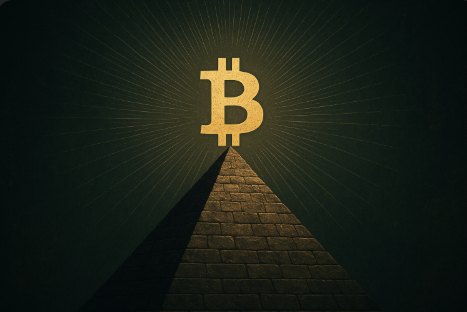
Bitcoin is such a thing. It is not merely a better form of digital money. It is money in its perfected informational form. And because of the unique way it was created, no one will ever make “Bitcoin 2.0.” This is not a matter of ideology or wishful thinking. It follows from a series of cold, rational facts about its origin, architecture, and game theory.
1. Immaculate Conception
Bitcoin was born in a way that cannot be repeated. Its creator, operating under the pseudonym Satoshi Nakamoto, launched the system in 2009 with zero pre-mine, no insiders, no venture capital, no privileged early access. The code was posted to a public mailing list. Anyone could download it, start mining, and participate on equal footing.
Crucially, Satoshi disappeared. The creation was detached from the creator.
The estimated one million bitcoins he/she/they mined have never moved. Whether Satoshi is alive or dead no longer matters. Even if they returned, they would have no special privileges over the network. They hold no keys that others do not, no administrative power, no legal ownership.
Every other cryptocurrency launched after Bitcoin has a team, a foundation, a CEO, a pre-mine, or some other centralising feature. These are not trivial differences. They shape the entire trust model. Bitcoin is the only digital monetary network that is genuinely ownerless and leaderless. It exists as a neutral protocol, open to all and controlled by none. That cannot be re-created now that the world is watching.
2. Neutral, Immutable Monetary Rules
When Satoshi released version 1.0, they locked in the essential parameters: the fixed 21 million supply cap, the difficulty adjustment, and the issuance schedule. These rules are enforced by thousands of independently run nodes around the world. Changing them would require near-unanimous voluntary coordination across the network, which is practically impossible.
Why? Because no one is going to vote on things that would very likely erode the entire value proposition of the network and ultimately destroy their own savings. Maybe some people may do so ignorantly, but a super-majority of the network?
This hard immutability is part of what makes Bitcoin unique. Other projects can promise fixed supplies, but their governance structures always allow for change under pressure. Ethereum, the second largest cryptocurrency, has changed its rules on many occasions, which puts lie to the claim of decentralisation and fatally undermines any current assurances.
Bitcoin’s rules are not merely written; they are ossified. As Satoshi noted, “the nature of Bitcoin is such that once version 0.1 was released, the core design was set in stone for the rest of its lifetime.”
This is the monetary equivalent of the laws of physics. You cannot bribe, lobby, or regulate the Bitcoin protocol into changing its money supply. No other monetary system, past or present, has offered this level of credible commitment.
3. Technological Absorption
Some argue that “better” cryptocurrencies could emerge with superior features. But any genuinely valuable innovation can simply be adopted by Bitcoin itself — if, of course, there’s broad consensus. Which there would be if any proposed change represented a low risk means to materially enhance the network.
This is not to contradict the previous point. Any proposed changes to how the network operates are distinct from what the network promises. We see this with fiat money. The US dollar’s assurances and characteristics are unchanged over many decades, but today you can move and use that money in ways unimagined in the 1980’s.
In fact, we’ve seen functional changes to Bitcoin already. Upgrades like SegWit and Taproot were added gradually through decentralised consensus. Neither changed the core promises of the network, but each added additional functionality.
Bitcoin can and does evolve, but only in ways that preserve its monetary properties and decentralised security.
Any rival chain would need not only to innovate but also to bootstrap the enormous network effects, security budget, and user trust that Bitcoin has accumulated. That is functionally and practically impossible. Technological improvements alone do not create a new monetary standard. History is littered with technically superior systems that lost to simpler but more entrenched alternatives.
4. Longest Proof-of-Work and the Lindy Effect
Bitcoin has been running continuously for over 16 years without central oversight or downtime. It has the longest and most secure proof-of-work chain in existence, backed by the largest pool of computational energy ever devoted to a single network.
This matters because monetary systems derive their strength from credibility. The longer a system survives and resists attack, the more credible it becomes. This is the Lindy effect: the future life expectancy of a durable technology increases with its age. Each day that Bitcoin continues to operate as designed increases the market’s confidence that it will persist indefinitely.
No competitor can simply conjure a 16 year track record. It must be earned through unbroken operation in the wild.
5. Perfect Informational Money
Before Bitcoin, money always relied on some form of physical substrate or trusted intermediary: gold, paper notes, or banks. Bitcoin represents a categorical shift. It is purely digital, purely informational.
Think about music formats. We went from vinyl to cassettes, to CDs, and finally to digital files. Once music became digital, there was no need for a “better format.” The medium had dissolved into information itself. From then on, the innovation shifted to distribution and applications built on top.
Sure, there can be different file types, but each are entirely interchangeable and convertible, and all convey the same information.
Information is the final stage. You cannot make digital more digital.
And Bitcoin is money’s equivalent of the digital format. Once value exists as pure information, there is no next step.
6. The Network Effect and Monetary Gravity
Money is a network good. The more people use a particular form of money, the more useful it becomes. This creates powerful winner-take-most dynamics. Historically, multiple monies have competed, but eventually, one tends to dominate as the global reserve standard. Gold once played this role. Now it’s the US dollar.
Bitcoin’s unique properties and neutrality make it the natural Schelling point for global digital value. As adoption grows, it pulls in users, capital, and infrastructure, just as a black hole pulls in surrounding matter. Competing monies cannot match this gravitational pull once critical mass is achieved.
Because Bitcoin is open, neutral, and incorruptible, it is the logical endpoint of monetary convergence in a digital world. There is no need for a “better” Bitcoin because the value lies not in branding or features but in trust minimisation and network dominance.
The Bottom Line
You cannot replicate Bitcoin’s origin story. The world now pays attention. Any new system will be perceived as centrally controlled or insider-driven.
You cannot offer significantly better features that Bitcoin cannot adopt.
You cannot instantly replicate its 16-year security track record.
You cannot improve on “purely digital” as a monetary format.
You cannot overcome its network effects without extraordinary force, which would itself undermine the neutrality of the new system.
Bitcoin is not just first. It is final.
Over time, rational economic actors will converge on the most secure, neutral, and widely accepted monetary network. In a world where capital can move globally at the speed of information, the advantages of Bitcoin compound relentlessly. It is already absorbing store-of-value demand from individuals, companies, and increasingly nation states.
As confidence grows and liquidity deepens, Bitcoin becomes more attractive, setting off a reflexive feedback loop. Like a black hole, its monetary gravity strengthens with every unit of value that falls in. Alternative stores of value gradually lose their appeal, not through coercion, but through rational choice.
It took 16 years for it to become the 10th largest currency in the world. And it happened entirely organically, without coercion, or direction from any one entity. If that doesn’t at least make you take notice, I’m not sure what will.
Addendum
A common misconception is that “the boat has sailed” or that Bitcoin is something to speculate on in the hope of making a quick profit. This misses the point entirely. Bitcoin is not a get-rich-quick scheme. It is money. A better money.
Nay, it is perfect money.
When is the best time to exchange the Argentine peso for the Australian dollar? The answer is simple: any time. Because one currency consistently loses purchasing power faster than the other. The same logic applies to Bitcoin. You are not “buying” Bitcoin to make money. You are switching to a superior monetary network that is harder, scarcer, and more resistant to debasement.
Whether the price is $1, $10,000, or $1 million is almost beside the point. What matters is the relative strength of the monetary systems over time. The history of fiat currencies is one of manipulation and debasement. That may vary in degree, but there are no exceptions to this rule.
Bitcoin, on the other hand, cannot be changed without the willing consent of almost all participants. All of which will be strongly motivated to preserve the very things that made them adopt it in the first place.
Bitcoin is not a product competing in a crowded market. It is a protocol that has already won the one race that mattered: becoming the first and only neutral, decentralised digital money. Its immaculate conception, ossified rules, security track record, and network effects make it a one-time invention.
The world will not need a “Bitcoin 2.0” any more than it needs a “TCP/IP 2.0.” It’s as ossified as the rules of chess, or algebra.
Once a standard is good enough and widely adopted, it becomes the bedrock on which everything else is built.
Bitcoin is that bedrock. Over time, it will continue to absorb monetary value globally, not by force but through the quiet, relentless pull of superior monetary physics. And the good news is, it is never too late to step off the sinking ship of debasing fiat currencies and onto the lifeboat of sound digital money.
Strawman is Australia’s premier online investment club.
Members share research & recommendations on ASX-listed stocks by managing Virtual Portfolios and building Company Reports. By ranking content according to performance and community endorsement, Strawman provides accountable and peer-reviewed investment insights.
Disclaimer– Strawman is not a broker and you cannot purchase shares through the platform. All trades on Strawman use play money and are intended only as a tool to gain experience and have fun. No content on Strawman should be considered an inducement to buy or sell real world financial securities, and you should seek professional advice before making any investment decisions.
© 2025 Strawman Pty Ltd. All rights reserved.