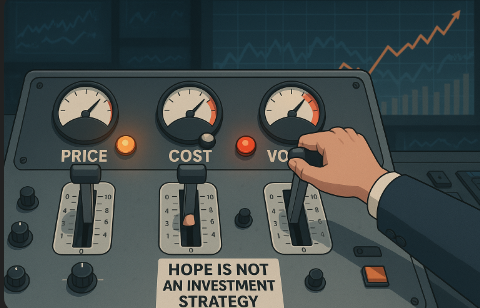
There are really only three levers a business can pull to juice its profits: price, cost, or volume. That’s it.
As an investor, your job is to figure out which of these levers matters most for any given company — and how management plans to yank it. Because if you don’t know what’s driving growth, you’re essentially investing on hope.
And, as I like to say, hope is not an investment strategy.
Why prices, costs, and volumes matter is obvious enough. But how they might evolve, and how management might best steer them, is anything but. Especially when changing one factor tends to have an impact on the others.
Higher selling prices, for example, are obviously desirable. But in the competitive free-for-all of open markets, few businesses get a blank check. Even if you’ve got the best product on the shelf, push prices too far and your volume will take a hit. At some point, customers will simply switch to the cheaper option.
Still, as Warren Buffett puts it: “If you are able to increase prices without losing sales, you have a very good business.” His go-to example is See’s Candies; a company that’s been steadily lifting prices for decades without losing its loyal following.
That kind of pricing power is pure gold. And more than anything, it reflects product quality. So if you’re looking for companies with such potential, steer clear of commodity-like offerings. Rather, focus on those businesses that deliver a product or service that’s meaningfully better than the competition’s.
(The exception here is when a company has an offering that can’t easily be swapped out. What might be called a “trap-door moat”. But even that won’t be enough on its own if you let quality slip too much.)
Cutting costs is also patently a good thing, and something management should always have an eye on. Indeed, efficiency can be a powerful edge in its own right, allowing you to undercut rivals and remain profitable at lower prices.
But when cost-cutting is the main story management is telling investors, it’s usually a red flag. More often than not, it signals either prior complacency or a lack of better growth options.
Telstra has been trying to cut its way to greatness since forever. Yeah, there’s plenty of fat to cut, but there’s only so much costs you can cut before you start to undermine product/service quality. Even if perfect efficiency is achieved, it’s a one-time benefit. And it wont stave off the reaper forever if prices and volumes are in structural decline.
Finally, we come to volume — arguably the most important lever of the three. Pricing power and cost discipline are great, but they’ll only take you so far. If you want any sort of sustainable profit growth, you’ve got to sell more stuff. Full stop.
Now, growing volume is actually pretty easy… if you don’t care about price or cost. Just blast the market with sales and marketing spend, slash your prices to the bone, and watch the units fly out the door!
But that’s not sustainable. What you want is a business that can grow volumes while maintaining — or better yet, expanding — its margins. That’s where the magic happens.
It’s also the most difficult thing to engineer.
Once again, product/service quality is paramount. And Tesla has been, to date, a good example of this. Putting aside its controversy seeking CEO, or the nose-bleed valuation of the stock, the company spends virtually nothing on traditional advertising but has still managed to grow volumes substantially over the last 5 years. Moreover, it’s done so without a material increase in (non-growth oriented) costs as it continues to fill out the production capacity of existing factories (which were designed from the start with much higher volumes in mind).
Contrast that with Harvey Norman — a business that has increased revenues 22% from pre-covid levels, but whose net profit has dropped ~13% over the same period. Go Harvey, go!
At the end of the day, evaluating growth isn’t just about spotting that it’s happening. It’s about understanding how it’s happening. It’s easy to see rising profits and assume the good times will keep rolling. But if you don’t know what’s driving that growth — price hikes, cost cuts, or surging volumes –you’re just extrapolating on hope.
And, importantly, you need to figure out if the growth is sustainable, and not engineered at the expense of things like product quality, brand strength, or prudent investment.
Smart investing means looking under the hood. Because when you know which lever’s doing the work, you’re in a much better spot to judge whether the engine’s still purring…or about to seize up.
Strawman is Australia’s premier online investment club.
Members share research & recommendations on ASX-listed stocks by managing Virtual Portfolios and building Company Reports. By ranking content according to performance and community endorsement, Strawman provides accountable and peer-reviewed investment insights.
Disclaimer– Strawman is not a broker and you cannot purchase shares through the platform. All trades on Strawman use play money and are intended only as a tool to gain experience and have fun. No content on Strawman should be considered an inducement to buy or sell real world financial securities, and you should seek professional advice before making any investment decisions.
© 2025 Strawman Pty Ltd. All rights reserved.