Consensus community valuation
Discl: Held IRL 4.06% and in SM
Very nice to see Gary continuing to buy AHL shares for his Super Fund. Based on the last few purchases, won’t surprise me if he picks up another ~$35k or ~$60k before the end of April as he seems to buy 2x in each of the month that he has bought ...


Discl: Held IRL 3.76%, SM
- Howard received 7,500 shares, not much to write home about, unfortunately ...
- Adds a beanie to the manufacturing-centric, male-only, Board ...
- There appears to be a Seeley International connection with Paul Procter, the MD/CEO who was the CEO there, and Howard was the Beanie

Discl: Held 4.01% and in SM
Poked around the Anacacia Pty Ltd share holdings after they announced a sale of 1.12% of their holdings in AHL late last week.
- The Anacacia Wattle Fund (APIR: ACI0632AU) is an Australian-based managed fund focusing on high-conviction, long-term investment in small-to-medium enterprises (SMEs) outside the top 100 ASX companies. As of January 2026, it manages approximately $259.93 million, targeting Australian equities with a focus on growth
- They seem to have been building a position in AHL since at least Dec 2023 (could be earlier but below the reporting threshold) at around $0.74, then topping up down to $0.64 since
Their 1.12% sale seems to me to be profit taking after a decent ~30%+ return over 2+ years.


Discl: Held IRL 3.94% and in SM
This was from the end-of-week Market Index summary. Each of those data centres/buildings need industrial cooling.
Augurs well for AHL in ANZ and in Asia, I think.

Discl: Held IRL 3.82% and in SM
Interesting Announcement just released by AHL. Very nice actually.
It is another important and very positive data point to my hypothesis that old man Gary is now completely comfortable with Paul Proctor MD/CEO and Donald McGurk, Non-Executive Director and Chairman.
- He has just thrown more money at them to lock them in through to 31 Aug 2027
- Both Directors have the same terms
- Nothing for himself, Gary
- Should have known, but didn’t realise the old Chair was nuked as well ...
Given the restructuring already done, with a bit more to go in Thailand, and now with this locking in of Paul & Donald, both who came into the business in the last 6M, it is probably "safe" to conclude that the AHL Leadership team is now “settled” from Board through to middle management.
Now they can get into, and focus on, the real business of execution.

The Board changes per Google for context:

Discl: Held IRL 3.57% and in SM

I just got off the AHL results call.
At first glance, the results were flat and underwhelming. But the call gave very good insights as to what has been happening in 1HFY26 and I think, connected many dots that didn’t previously make sense. Still need to work through the numbers - lots of restatements to work through from FY25 as AHL accounts for the sale of the Kiwi business etc.
SO, it is now clear to me that:
1. The other 2 CEO’s prior to Paul Proctor were duds, which old man Gary would have been uncomfortable with, and nuked them.
2. Paul appears to be Gary’s man. In the 6M that he has been at AHL, it appears that he has had the support to the Board to undertake what now comes across as a resonably comprehensive company restructure where:
- The team pre-restructure “could not provide the leadership and development to the teams”.
- Younger, less experienced and heavy overheads were replaced by 20-30 year veterans, experienced in the Distribution and manufacturing business, have more expertise and are more hands-on - they are now working as a team around a strategy they understand and believe in.
- The factories report directly to Paul, cutting out an expensive Exec General Manager sitting in between Paul and the factories
- A “leaner organisation”, “more empowered” and “improved operating culture” has emerged for AHL “to move into a structural growth phase”
- AHL is now focusing on building up the middle level management, engineering and business development roles to expand the skills it needs, particularly in HTS
- While in the past 2 years, AHL has reported that Thailand has been optimised, looks like Paul has gone deeper - a decent team revamp, consolidating of seperately located physical facilities into one footprint and a full re-configuration of the facilities is underway, to be completed by June 2026
3. Paul did make one thing clear - the objective of the restructuring was not to cut cost. The key principle is to improve the ability of the organisation to execute on its strategy.
4. This does help explain why old man Gary was topping up on his shareholdings, on market, in Nov-Dec 2025 - it would appear that he believes he has finally found the person who can lead AHL in its next phase of growth, supports the actions taken, and he has demonstrated that faith via adding more coin in AHL.
5. Paul comes across very understated and I liked how he went about explaining what has happened and why. Because of this overstated approach, it does feel like I can place a decent degree of trust in his and the CFO’s guidance that the benefits of the restructuring are starting to be seen in these early months of 2HFY26.
In a business that is very old school/real world Design -> Manufacture, and Aftermarket Distribution, this pivot back to experience vs younger, more technology savvy management makes good sense. Given what sounds like pretty decisive changes, I am getting a pretty good feeling that AHL has turned a corner and is now set up right for growth in both HTS and Distribution.
Coupled with the complete lack of AI-mageddon exposure, AHL is turning out to be a very robust old-school growth holding in my portfolio.
I will be reviewing the results with the view that AHL has been chewing-gum-while-running in 1HFY26.
Discl: Held IRL 2.86% and in SM
Good to see Gary and Karen Washing, the co-founders buying about $59k of AHL stock on market. A few interesting points about this purchase:
1. It is barely 0.13% of the the 49.3m shares they currently own.
2. This is the first time that the Founders have transacted on AHL shares since AHL’s listing in Sep 2022 - shares were released from escrow in Mar 2023, 2.5 years ago, and they chose to buy
3. It also comes on the back of the CEO’s small on-market purchase on 19 Nov 2025
Could this be a sign that the Co-Founders are comfortable with Paul thus far, I wonder? I ask this as they could have got a significantly better entry point to add shares in the last 1.5 years, since July 2024, during which 2 CEO's came and went, but they chose to do it now when the share price is moving to levels not seen for some time.
Regardless, as small a purchase as this is, given their track record of no transactions in the past 3 years since listing, this can’t be but a good sign ...


Adrad is profit and cashflow positive with every expectation of remaining so and has a very undemanding PE under 10. Growth is anaemic but positive with several catalysts in play to maintain or grow it (Alu Flue, Data Centres, Thailand margin and Asia market options), but management changes, operational execution and founder over hang (60% shareholder) are areas of concern that seem to have let the share price wallow for the last few years and may continue to impact investor returns.
So in reviewing the business, I compare to my thesis from when I bought in in 2023, it had IPO’s less than a year earlier and was down on the IPO price by over 30%. Darryl Abotomey had stepped in to fill an CEO void and brought credibility and a good track record to a company that had little of either on the ASX. His departure as CEO was not an issue as he took a place on the board, but now he has left the board the gap is telling – so does this break the thesis?
Reviewing the key thesis drivers from when I originally invested:
1. Management acuity: Darryl was the key element of this, the alternative was that post his departure that enough of his influence was culturally embedded that it was less of an issue. But the recent turnover of CEO and Chair kills that possibility and I have little insight into the founder who owns a lot of the company and I assume is a key voice on the board that may be why Darryl left.
2. Established Niche Leader: Adrad is the leader in Heat Transfer Solutions in Australia, this seems to be maintained but we don’t see any tangible improvements in the business based on this leadership. The increase in data centre work is promising as is the Alu Flu, but noting to get excited about yet so it’s hard to attribute any value to these or expectation of growth.
3. Profitable: The company remains solidly profitable, the problem however is profit growth is lacking due to costs have increased 17% in the last 2 years, sales by 7% but thanks to improved gross margins, gross profit has improved 10%. So Net Profit % has dropped from 3.9% to 3.7%. Costs have gone up 12.0m (ignoring IPO costs), 4m in straight employee costs but another 3.1m “employee type” expenses (Labour hire & Trave, training,…) have been added to other expenses.
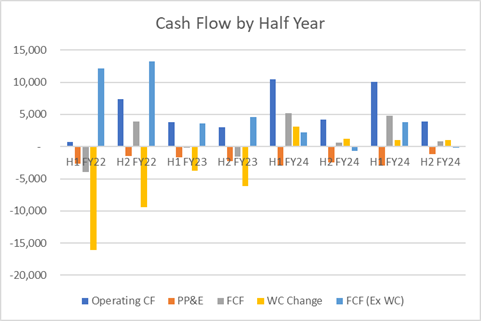
4. Cash: Working capital changes have impacted this over the years but in general FCF has been solidly positive. There is also $18m of cash on hand, so the business is well funded and almost a third of the market cap is backed by cash.
5. Operating Leverage: Gross margins have improved as anticipated, but we are not seeing operating leverage due to operating costs. It could be a case of settling the cost base of the business over the last couple of years to that suitable for a listed company, but this has been a problem. Fixing it is an opportunity for operating leverage, but there is no evidence of it happening or being prioritised strongly. The NZ operation exit earlier this year will help it should be noted, but more is needed.
Conclusion
Thesis is mostly busted.
I no longer intend on holding Adrad to wait for the thesis play out, but am not dumping my shares in a rush. I view it as undervalued even if the thesis doesn't play out, with a value of almost double the current price if top and bottom line can grow at 5% and the PE lifts to around 15 over the next few years. Even at the current PE it’s worth $1.10 on those assumptions at a 11% discount based on modelling I have done (acknowledging this is ball park, but a clear margin of safety).
I am also not rushing because it is very thinly traded and that also flags a major issue I will be more mindful of in the future. Namely the 60% odd holding by the founder and also the lack of shares held by other directors or KMP’s or used in CEO incentives. I suspect control issues with the founder based on this, which may be the reason for Darryls and the previous CEO’s departure, but simply not knowing much about the founder who controls the company is an issue.
Disc: I currently own but intend on selling due to thesis concerns and seeing better opportunities.
First crack at using @Strawman 's Intrinsic Value approach.
- I used 3 scenarios, assumptions are laid out underneath each scenario
- Rather than use EPS, I used FY25 Operating Profit instead as that felt like a "purer" view of earnings
- Stayed with current PE of 8.82x, as it is conservative, undemanding and reflects current cost concerns
Appreciate feedback/reactions to the approach taken! Doing the valuation helped put the AHL FY25 results in better perspective and was an extremely valuable exercise.

Discl: Held IRL and in SM
Finally had a chance to have a closer look at AHL’s results. Also used the AHL results to work through a PE-based valuation, which I will post separately.
OVERALL
- Operations are chugging along and revenue growth from operations is 8.9%
- HTS continues to spearhead growth - consistent comment on backup generation for Data Centres driving HTS growth and this looks like it will continue
- The issue is cost - cost increases have dented profitability, but the increases are not really thesis breaking:
- Inventory increased 2.6% to support the Data Centre projects - this, plus evidence of higher Contract Assets in the Balance Sheet, up 114.7% from $2.8m to $5.9m YoY, provides good comfort that HTS is indeed firing
- A good ~$1.6m is due to a on-off Impairment of $1.0m and $0.6m of Forex losses, both these alone accounted for 1.2% of the 10.0% YoY cost increase and 1.1% of Margin
- Forex movement has been more favourable in 2H, and looks to have continued into FY26
- Cash position remains healthy - up $2.3m, 14.8%, $18m cash balance, $0.6m borrowing's - balance sheet is in decent shape
- Dividend 3.48cps, up 18% from, 2.94cps, 50% of FY25 Statutory NPAT
- An ongoing concern is the churn in CEO’s
AHL was intended to be a steady-grower-with-dividends ballast to my growth-centric portfolio and remains so. While the rising costs remain a concern, my thesis, which is predicated on (1) revenue growth, underpinned by AHL’s monopoly-like position in the Industrial Heat Cooling space (2) increasing demand for Data Centre cooling is still intact.
Have valued AHL at $0.86, based on the current undemanding PE of 8.82x, which is mostly held back by the ongoing cost concerns, so this appears more less “fairly valued” now.
The share price has stayed “recovered” despite the cost concerns, crossing and staying very much above the 200SMA. It does seem that the market is being patient and settling for the long haul ...
Am already at ~3.0% allocation, so will take no action.

OPERATIONS
Chugging along
HTS
- Nothing to not like in HTS
- Ingredients are in place for Asian expansion - Sales capability, prototypes, manufacturing facilities
- AluFin is progressing
- Strong demand in data centre cooling
Distribution
Nothing negative, but this is probably unexciting, in relative terms.
FINANCIALS
Total Revenue rose 8.9% YoY - Both segments have contributed to the increase in revenue but Heat Transfer Solutions revenue has risen more than Distribution revenue
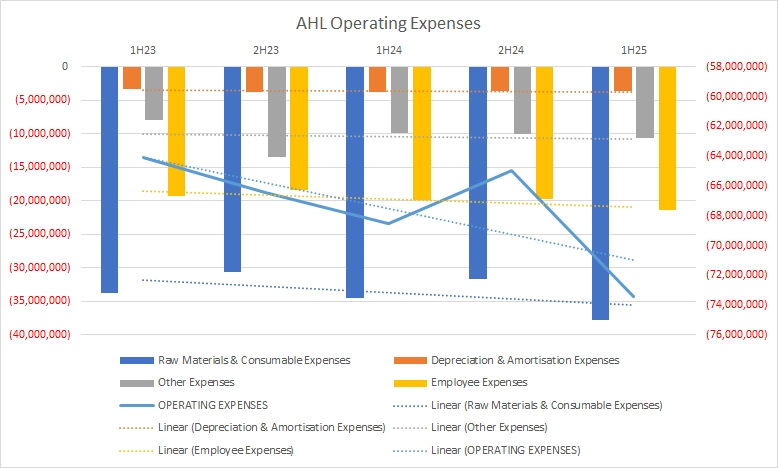
Costs have increased 10% YoY:
- The pace of Raw Materials & Consumable Expenses growth is greater than both Employee Expenses and Other Expenses
- Despite improving 6.8% HoH, Raw Materials & Consumables Expenses have increased 12.5% YoY

Revenue has been steadily increasing, but increasing costs have steadily eroded profitability and profitability margins. This is really not a pretty picture and one that troubled me. But it is clear that the issue is not revenue, it is cost-driven.

3 things stuck out when having a closer look at the P&L detail
AHL Took a R&D Impairment of $1.0m in FY25 - this related to the building of new equipment where it was found that the materials used in the prototype were not suitable for subsequent product manufacturing in commercial quantities - asset will be retained, to be revisited later.
There was a loss of $0.5m of Other Income comprising (1) ($0.2m) of Grant Income (2) ($0.1m) of Net Franchisee Fees (3) ($0.1m) of IT rebates (4) ($0.1m) Other Income - despite this, Total Revenue still rose 8.3%, driven by the 8.9% increase in Sales to External Customers - this normalising of Other Income from FY24 continues the downward trajectory of Other Income from FY22 (FY22: $1.3m, FY23:$1.7m; FY24: 0.9m; FY25: $0.2m)
Other Expenses rose $2.2m YoY driven by (1) $0.9m increase in Impairment Loss (2) $0.4m of Forex Loss (3) $0.16m IT Cost (4) $0.4m Other Expense - as the AUD strengthens, and there is no further impairment, expenses could decrease between $0.9m to $1.3m in FY26, all things being equal.


The picture looks much better when the $1.6m Impairment and Forex Loss is added back to to Operating Expenses
- The YoY expense increase drops 1.2% from 10.0% to 8.8%
- Margins come in at 7.2% instead of 6.1%
- Once these 2 mostly uncontrollable costs are stripped out, the cost increases feel a lot more palatable


- 5.1% fall in Cash flow from operating activities but more than offset by a 21.8% fall in Cash Flow from Investing activities
- $2.3m increase in cash, up 14.8%
- Dividend 3.48cps, up 18% from, 2.94cps, 50% of FY25 Statutory NPAT

- Contract Assets is up 114.7% to $5.9m - data centre and project orders pending customer delivery
- Inventory increased 2.6% to support the Data Centre projects

Good to look at micro, company-specific matters, to take a break from the chaos of the maro world!
Discl: Held IRL and in SM
SUMMARY
1HFY25 results were disappointing.
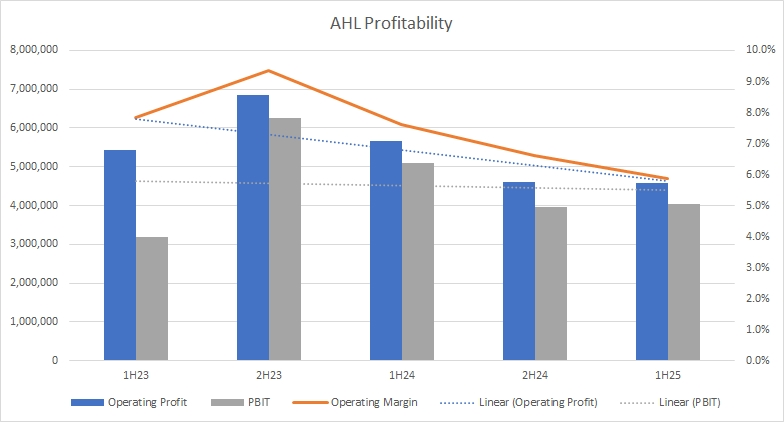
A steady 6% increase in revenue was more than offset by higher raw material and employee expenses, resulting in lower EBITDA (16.9%) YoY, lower NPAT (9.7%) and a drop in Operating Margin from 7.6% 1HFY24 and 6.6% in 2HFY24 to 5.9% in 1HFY25.
However, my revenue-focused thesis is playing out. HOLD.
POSITIVES
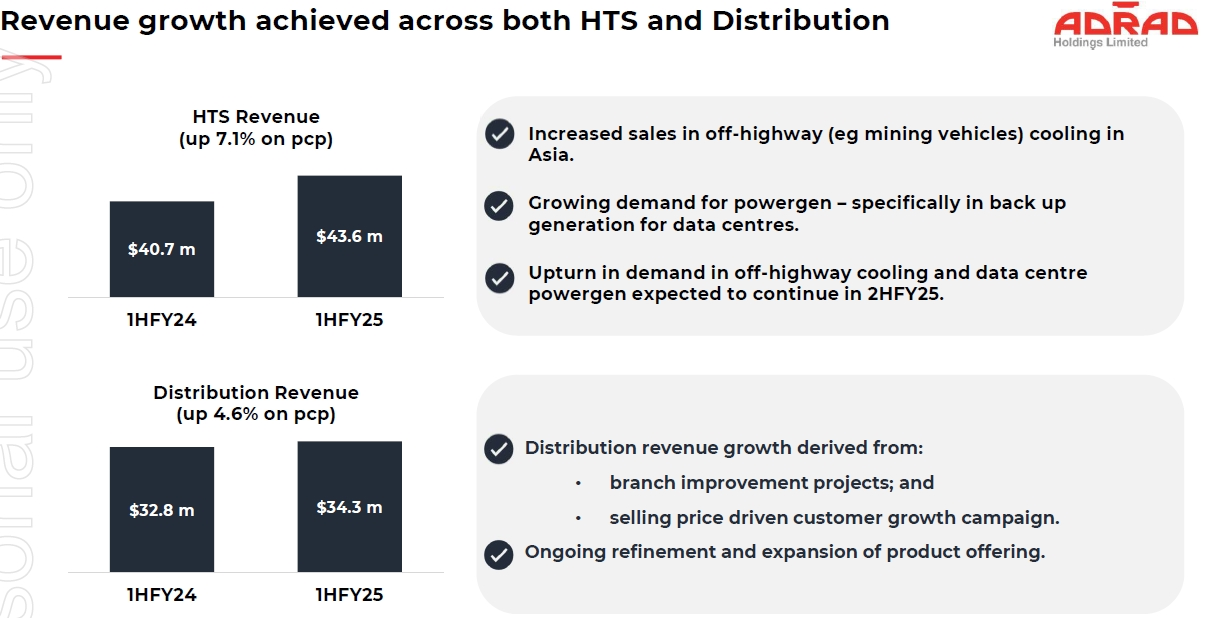
Revenue continues to grow nicely across both segments
HTS - up 7.1% vs pcp
- Traction in Asian Rail project, which is the outcome of an increased focus in Asia from AHL’s Thailand operational base - 1st Asian rail project won and will commence in 2HFY25
- 1st Orders for AluFin - prototype for above ground mining vehicles - good traction in AluFin, primary target market $15m-$30m revenue
- Rail Service - $9m orderbook expansion to replace cooling units in Victorian trains
Distribution - up 4.6%
- Branch improvement projects
- Selling price driven customer growth campaign
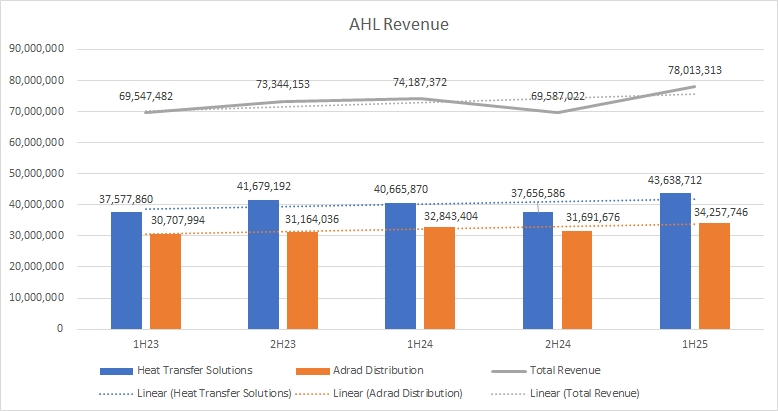
Continued good cash generation - $10.1m of cash from operations, $3.3m net increase in cash after (2.9m) capex spend, ($0.7m) debt repayment and ($1.3m) FY24 dividends paid
Balance sheet remained in good shape and strong - $19.1m cash, $0.7m borrowing's (down from $1.4m 1HFY24), Inventory flat $0.4m increase to $47.7m as Distribution stock reduced from increased turns offset by higher HTS raw materials in preparation for uplift in 2HFY25 manufacturing activity
Thai manufacturing facility is now complete - lower manufacturing economics should start to flow through more clearly - will facilitate insourcing
DISAPPOINTMENTS
After good cost improvement in 2HFY24, Operating Expenses have increased back to the overall cost increase trendline:
Raw Materials & Consumables are now in a noticeable upward trend:
- Deteriorating AUD purchasing power
- Increased direct input costs
Employee Expenses are also in an upward trend, although not as steep as Raw Materials & Consumables:
- Wage & Super uplift from 1 Jul 2024
- Sales team boost has kicked in
Additional Insurance costs, doubtful debt provisions, FX costs have also added to costs.
Customer Growth campaigns in FY24 to reduce pricing to grow customers, now returned to pre-campaign normal pricing - seeing revenue increase from increased volume from increased customers
Management understands the reason for cost increases and have taken action - need to see this filter through in 2HFY25.
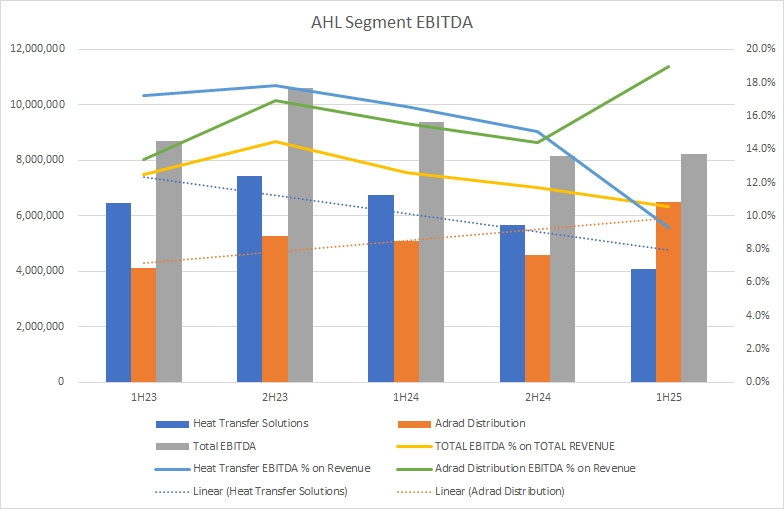
Distribution EBITDA is on a clear upward trajectory, HTS EBITDA continues to trend downwards as the cost increases impact HTS directly.
THESIS REVIEW
Thesis was predicated on:
- Revenue growth from HTS given dominant market position on Industrial Cooling, domestically and in Asia - tick
- Growth from AluFin taking off - good positive greenshoots, tick
- Thai manufacturing facility would give AHL an Asian base, from which to deepen penetration to Asia - tick
- Thai facility will also lower cost - cautious tick on this, the issue this half was more raw materials/AUD driven - without the Thai facility, the cost increase could well have been worse
Cost advantages was not an explicit part of the thesis, although arguably, there was an implicit assumption that costs would stay under control and contained - the cost increases this half has knocked this assumption around a bit
- Management is aware of the challenges and have and will continue to focus on cost management
- Pricing increases will have kicked in in 2HFY25, expecting ~$2.5m to kick in - $1m from Distribution and $1.5m from HTS
In summary, while the cost increases have impacted EBIT and NPAT, and the downward trend of both is not great, the revenue-related thesis is actually playing out.
Still too early to call this result a thesis breaker, but will need to see improvement in cost increases to arrest the increasing trajectory.
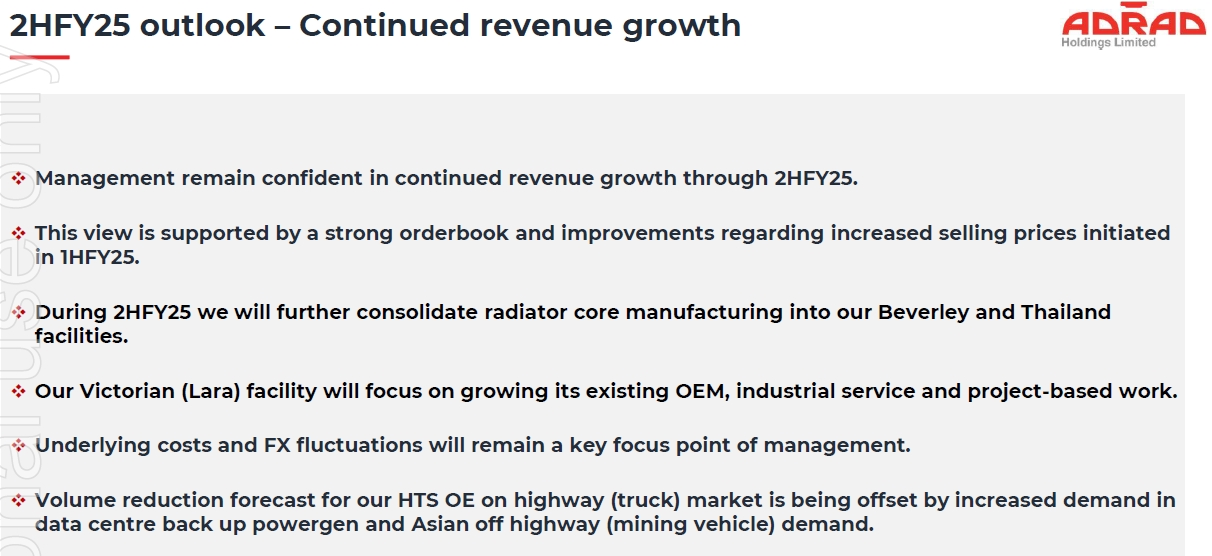
2HFY2025 OUTLOOK
Need to see:
- Continued revenue growth from both HTS, from Data Centre demand, and Distribution
- Continued manufacturing leverage from the Thailand facility move
- Cost containment measures kicking in to rein costs back in
Portfolio Action
HOLD. Current allocation of 2.98% is about right
In a quick review of AHL's AGM material and speech, picked up 3 subtle points to note to manage expectations:
- Strong order book for data centre power generation - significantly higher than FY24
- FY24 deferred projects commenced - this was as guided previously, but good to confirm
- Full year FY25 revenue and earnings weighted to 2HFY2025, presumably from the revenue of deferred projects and data centre projects hitting later in the year given the longish gestation period for these sorts of projects. Implies 1HFY2025 growth could be flattish
Have been trying to top up around $0.75 these past few months but there has been very little decent volume of above 5,000 units available to make a purchase worthwhile. Patience is absolutely needed!
Discl: Held IRL and in SM


My notes on AHL's FY24 results. As I was reviewing the Annual Report, the following 2 longer term growth areas for HTS crystallised, particularly the commentary around Caterpillar recognition, both of which now forms the core of my refined AHL thesis. Am trying to get more information on AHL's relationship with Caterpillar to work out how far it could potentially go with AluFin.
Discl: Held IRL and in SM
KEY LONGER-TERM GROWTH AREAS FOR AHL
Cooling systems for Data Centres - demand for AHL’s cooling solutions will grow as demand for Data Centres grow globally driven by the AI boom. Thailand manufacturing facility is well place to support growth in this area in the Asian region
Battery powered above ground mining equipment is set up for significant growth once the cooling technology matures.
- Supplier recognition by Caterpillar is a really good positive sign
- Cat appears to be targeting 2028 for the production rollout of Cat battery-operated trucks - the mining industry is under increasing pressure to transition to green technology and there is a whole existing fleet of mining equipment which will require upgrading to battery-operated operations once the battery-powered technology matures
- An efficient and cost effective cooling system is an integral part of the green equipment which is where AluFin is targeted at
FINANCIALS
Weaker 2HFY24 and weaker FY24 overall, but no surprises as guidance was provided in May 2024
FY24 earnings issues in HTS appear to be transitory, not permanent due to customer project slippage which is anticipated to be restarted in FY25 - expect to see some recovery in HTS in FY25
Revenue of $142.8m came above the midpoint of revenue guidance of $140m to $144m
EBITDA Proforma came in at $18.1m, at the lower end of the $18m-$19m guidance - HTS One off $1.5m costs were incurred, impacting EBITDA, also previously flagged
BALANCE SHEET
Strong cash generation from operations continues
Inventory reduced by $7m - focus in this area bearing fruit
Capex investment makes sense in terms of Thai plant expansion

OPERATIONAL UPDATES
Senior Leadership Team is now fully in place with the onboarding of the new CEO Kevin Boyle in Apr 2024
Internal re-organisation completed with key segments being (1) Heat Transfer Solutions (2) Distribution and (3) Group Support
This is the ongoing maturing of the AHL organisation that Daryl Abotomey discussed during the SM meeting.
HEAT TRANSFER SOLUTIONS
Positive Developments:
- Expanded the scope of our after sales service offering by providing more services for our customers’ equipment along its path from manufacturing and commissioning and throughout its serviceable life
- Off-highway segment continued its positive trajectory
- Continue to pursue operational efficiencies as we finalised construction of the factory extension and new offices, factory floor re-lay and new equipment commissioning at our Thailand plant.
- Continued progress on AluFin product development with a number of global mining players on multiple fronts- field testing in underground mining equipment, developing a prototype for above ground mining dump trucks, field testing units in on road transport and service testing of an auxiliary cooler module for battery electric powered above ground mining equipment -
- Awarded the Supplier Excellence Recognition award by Caterpillar; an award which recognises top-performing suppliers who have met or exceeded rigorous requirements and achieved world-class certification levels under Caterpillar’s Supplier Excellence Recognition program
Negatives offsetting the positives:
- Continued negative volume pressure in our OEM mining vehicle market in Asia.
- Conditions in the Australian domestic mining and energy sector saw a number of projects with their associated demand for cooling applications deferred.
- We expect most projects to progress in FY25 and we retain a positive outlook for this sector
DISTRIBUTION
Inventory reduction was a big management focus in FY24
Another year of top line revenue growth from a greater volume of sales across the range of categories we supply to the industrial and automotive aftermarkets.
Continued to emphasise our primary focus on cooling applications in industrial and vehicular sectors but also added to our product range with the introduction of fuel pumps and harmonic balancers amongst others.
More actively engaged in dynamic pricing to be more competitive across our product ranges and drive continued market share growth.
GROWTH OPPORTUNITIES

THESIS REVIEW
No change in thesis - business is steadily improving and growing, albeit with FY24 headwinds in HTS - these appear to be transitory
Positioning early for the longer term growth in HTS from Data Centre growth and AluFin opportunities in mining, especially when the global mining equipment players complete the current development phase of green technology equipment and massive fleet replacements from combustion to green technology occurs
Happy with 2.8% position size. Will top up position to 3.5% on any weakness below 75c, which is an attractive entry point given AHL’s all-time low price of ~64.5c

The last FY results from Adrad weren't spectacular, but not unexpected and revealed some cause for improvement. Maybe that's far from a glowing endorsement, but when shares are on a single digit PE you dont need to expect a lot -- and it seems the market's reaction reflects this. Moreover, beyond any specific 12 month period, the business still remains sound with potential for decent growth. At least in my opinion.
So 1.2% growth in revenue is essentially flat, reflecting stable growth in the distribution segment (revenue up 4.3%) which is offset by project deferrals in the Heat Transfer Solutions (HTS) segment (a drop of 1.2% in revenue) -- which largely seem like a timing issue as they are expected to recover in FY25
The 10.9% drop in EBITDA isnt what you want to see, and while that partly reflects higher warranty claims, a big part is due to their product upgrade program -- about $1.5m worth. Excluding this, which you would hope is building the foundations for future growth, EBITDA would have been only 3.4% lower.
(Statutory NPAT was up, but largely due to favourable comps when you look at IPO related costs. Pro Forma NPAT was down 23%)
Also, the Thailand facility expansion required new equipment and a restructuring of the engineering and sales teams. These investments are expected to improve operational efficiencies, reduce costs of goods sold (COGS), and support future growth by increasing capacity to manufacture products locally rather than importing them.
They also talked about an ERP upgrade (probably needed, but always makes you a bit nervous), as well as improved IT infrastructure.
Remember, the plan here is to transform a solid, but somewhat inefficient legacy business into a leaner, more optimised operation (something Darryl Abotomey has serious form in.)
We saw improved margin in distribution, inventory reduction thanks to improved processes, and range expansion. And customers continue to grow:

Speaking of inventory reduction, that drop in working capital helped boost operating cash flows from $7m to $14.7m (there was also a $2m tax benefit)
It was good to see the balance sheet improve -- cash increased 13.7% to $15.8m, while debt reduced 51.5% to $1.4m. The company paid out 40% of profit as a dividend, or 2.94cps. That gives a backwards yield of ~4% fully franked. Based on pro forma profit the PE is 9.3x (even after today's 9% pop).
I cant really see too much wrong with this picture. They will continue to modernise this old family business, build more capacity and capture more share. It's profitable, dividend paying and with a strong balance sheet. Yeah, capital orders will always be lumpy, but this is a proven business that has operated across many cycles, and I think low double-digit profit growth is absolutely in play for the next few years. (perhaps mid single digit revenue growth, boosted by efficiency gains -- and there's a good deal of low hanging fruit here)
I know it sounds a bit like a PE-type play, which is more about financial engineering rather than enhancing operational effectiveness and product-market fit, but based on what Darryl said when he spoke with us, this is much more about operating smarter and more efficiently, while still remaining focused on delivering value for customers.
Happily Held.


AHL has weakend in the past 2 weeks on no news. The thin volume makes it very hard to buy a meaningful number of units to make the brokerage worthwhile. Took the only super-short window available today to top up at 0.93 as there was some decent volume on offer as well as the price being smack bang at the 38.2% rectracement level - both rare occurences!
If it weakens further, the next entry point that I am looking at is ~0.885, which is the 50% retracement and 200 Daily Moving Average.
Discl: Held IRL and in SM.

Investment Thesis & Valuation
Thesis
The following key factors are being relied upon for this investment:
1. Management acuity: without Darryl I lack the confidence that there will be rigorous business discipline in operating and investing decisions. Provided he remains a director he can guide and supervise the new CEO starting in April. After a few years it will be come less of an issue as the company management culture should have absorbed his experience. The founder on the board also provides an important industry experience skill set which needs to be maintained if he leaves to ensure technical engineering matters are understood by the leadership.
2. Established Niche Leader: Adrad is the leader in Heat Transfer Solutions in Australia, maintaining this with innovation, business and operational efficiency is critical. Opportunities in Asia are important but more important is dominating it’s base market to provide leverage overseas. A change in the relationship with Kenworth Australia is a specific risk.
3. Profitable and Cash: There is no good reason for the business to go into losses other than it’s in major trouble, no large growth opportunity worth chasing by making losses and burning cash to reach. WC will impact FCF as it has to date (see graph), but should become less of a factor going forward and when taken out FCF should be strong.

4. Operating Leverage: With modest sales growth expectations and opportunities, a significant amount of value (EBITDA) growth is going to come from margin improvement and cost management. Operational changes underway and planned are expected to deliver these over the coming years, my bear case excludes these improvements and has a value under the current price as a result, so they are critical.

Other factors of note: Orange rather than red flags if they go negative
· Ownership: The founding director owns 61% of the company and other directors and KMP don’t own any. I like the skin in the game of the founder but don’t know him at all (but longevity of the business is a big plus) and would like to see other directors and KMP have stakes in the company that are economically important to them.
· Earning Stability: The OE business has long lead and tail work timelines and once established as a supplier, very sticky revenue. This is a bit like a SAAS business in it’s recuring nature and stability. Changes in technology to shorten the development cycle will challenge this stability.
· Alu Fin: setbacks and delays in this opportunity would lead to questions of what will grow sales and how strong their leadership is.
· Margin: I expect a slow but continued improvement in margins from the switch to Thailand and the reduction in duplicated costs. FY24 isn’t likely to show much but if guidance for FY25 doesn’t suggest noticeable improvements then deeper questions on the progress of efficiency improvements need to be answered.
· Working Capital: AR and AP will require attention but are expected to grow with sales. Inventory should either shrink or grow at a much lower rate than sales to reflect improved management and turns as guided.
· Acquisitions: Small add on’s within the specialist area are fine, but large acquisitions or those that expand operations out of Adrad’s niche will need a full review of the investment Thesis.
· Free Float: The lack of liquidity on market is both an opportunity and threat for small investors, but the bigger issue is how they “fix” it… 20% of the shares came out of escrow in February, so how this is handled will also give some indication on how shareholders are treated.
· Electrification: Not an imminent threat or opportunity for EV’s, Hydrogen opportunity is low odds, EO market supporting data centres and electric infrastructure is the tangible current opportunity. A space to watch to see how technology, markets and legislation develops.
· Warranty: H1 FY24 high warranty expense relates to issues that have supposedly been corrected. Ongoing high warranty expense would signal operational issues that will impact margins and may spill into brand damaging sales impact.
Valuation
Using a terminal year of FY28 for DCF and PE based calculations my base case valuation is $1.53 (IRR 17.5% at current price of $0.90). Growth is in line with FY24 guidance at 7% but modest given the expansion options across the market. Margins are expected to improve and so I increase these to 55% by FY28 but see this improving or Opex growth being below my 5% estimate given their focus on EBITDA% improvements. Assume EBITDA% reaches 20% and NPAT% reaches 11% by FY28.
Working capital will soak up cash as sales grow, but improved inventory management and ranging I expect should keep this to around 2% or well below sales growth. With a discount of 11% and PE assumption of 12.5 the value ranges from $1.60 to $1.45 on the bases case.

Summary
A stable, profit making, cash generating business with a long history that is expanding operations under experienced and credible management taking advantage of new market opportunities. Not a 10 bagger but a possible 3-5 bagger at current prices in the next 5 years on an un-demanding rate of growth adding to operating leverage from scale and operational efficiencies.
Expect 3+ year investment time frame to realise value. Comparables to IPO years and current year operational transitions are going to provide a muddy financial view for investors that may be discounted by the market until a few consecutive halves show consistency.
Disc: I own RL
Company Overview
Adrad is an aftermarket suppler of heat transfer solutions for heavy automotive/transport and power generation via a wholesale distribution of standard parts or bespoke manufacture. Growth, improved margin and capital efficiency is expected from further movement of production to Thailand, range focus and opportunities in Asia.
Corporate History
· Founded in 1985 by Gary and Karen Washington with a focus on delivering reliable and efficient heat transfer solutions to the aftermarket segment that meet the needs of its customers across a broad range of industries including automotive, transport, mining, construction, agriculture and energy. Adrad has an established network of branches, workshops and manufacturing facilities across 8 main sites and 16 warehouses in Australia, New Zealand and Thailand. Adrad is headquartered in Beverley, South Australia and has approximately 500 employees
· Adrad IPO’s on the ASX on 30 September 2022 at $1.50 raising $22m from investors. $15m was for the sale of new shares and $7m the sale of SaleCo (The shareholders and directors of SaleCo are Mr Glenn Davis, Mr Gary Washington and Mr Donald McGurk and the Company Secretary of SaleCo is Ms Kaitlin Smith). Use of Funds:
- 5.3m - PP&E in Thailand & Australia (OE)
- 1.0m – Expand Thai manufacturing facility
- 2.0m – PP&E (Aftermarket)
- 4.3m – Working Capital
- 3.6m – Offer Costs
- 5.8m – Existing shareholder sales
· Harrop Engineering Australia Pty Ltd ACN 134 196 080 (Harrop engineering) is a related party of the Company. Harrop Engineering’s sole shareholder is the Existing Shareholder, and Mr and Mrs Washington are also directors of Harrop Engineering. Harrop Engineering was previously a wholly owned subsidiary of the Company. It was transferred to the Existing Shareholder as part of the restructure which occurred in October 2021, and is no longer part of the Group. The Company and Harrop Engineering are parties to a longstanding supply arrangement under which the Company supplies certain heat exchange products to Harrop Engineering. the price for products supplied to Harrop Engineering is calculated at cost plus a markup which equates to a relevant gross margin of approximately 24.8% for the Company there is no fixed term. FY21 sales were $1,071k (<1% of total sales).
· Related Party: The rent payable under the Harlaxton Leases and Arlyngton Lease increases by 4% per annum, subject to periodic market review.
Business Operations
· Adrad operates across two main segments:
- Distribution (Aftermarket) – Australian manufacturer, importer and distributor of radiators and other heat exchange products for the Australian automotive and industrial aftermarket.
- Heat Transfer Solutions (Original Equipment) – Designer and manufacturer of OEM industrial radiator and cooling systems from its facilities based in Australia and Thailand.
· Distribution (Aftermarket): automative and industrial heat exchange products of which around 2/3 are third party sourced and 25% sold via the Natrad franchise network of 46 stores (at IPO). Non-franchise pricing is flexible to react to landed cost and raw material cost changes to maintain margins. The supplier base is diverse with over 60 wholesale and parts suppliers, the top 10 accounting for approximately 46% in FY21. 16 distribution warehouses across Australian and New Zealand service the network.
· Heat Transfer Solutions (OE): address On Highway (Trucks) and Off Highway (Construction, Mining & Rail) mobile segment and stationary segment of Industrial (below 1MW in engine power) and Power/Energy Generation (above 1MW – remote power generation stations). Using lean and flexible manufacturing principles from one off projects to full just in time capabilities in Australian and Thailand as well as R&D capabilities to validate thermal performance. OE supply or project work may be from a few months to a few years but after sales service and repairs can extend 5-20 years. There a few formal fixed-term contracts and Adrad employs Business Development and Sales teams to both prospect for business and manage customers.
Strategy and Direction
· Investment Decisions: Adrad is transitioning from a Privately owned and run company with loose investment decision criteria to one focused on return on funds invested under new management. “Sweeting Assets” to reduce working capital and target a 15-20% return on funds invested and a focus on PBT & EBITDA outcomes rather than just sales growth should see operating leverage improve but sales growth will be modest.
· Power generation: Data centres provide an opportunity for OE colling systems for generators and some traction exists in Australia but the Asia market will require the development of a lower cost product and take time to penetrate.
· Aluminium: radiators and cooling systems are moving from Copper/Brass based to aluminium due to weight and cost but aluminium expands and contracts significantly more with heat so requires specialist design to fit and for connecting parts which Adrad is leading on developing. Not worth patent protecting, but trade secrets and processes provide competitive protection of sorts.
· Thailand: Adrad has had basic operations in Thailand for around 10 years, but is now in the process of transferring all manufacturing there, leaving design and engineering in Australia. The manufacturing footprint in Thailand is growing and the equipment is being upgraded or transferred from Australia. There is currently a period of duplication of inventory and costs while this transfer takes place but once finished there should be significant efficiencies that improve EBITDA and operating leverage.
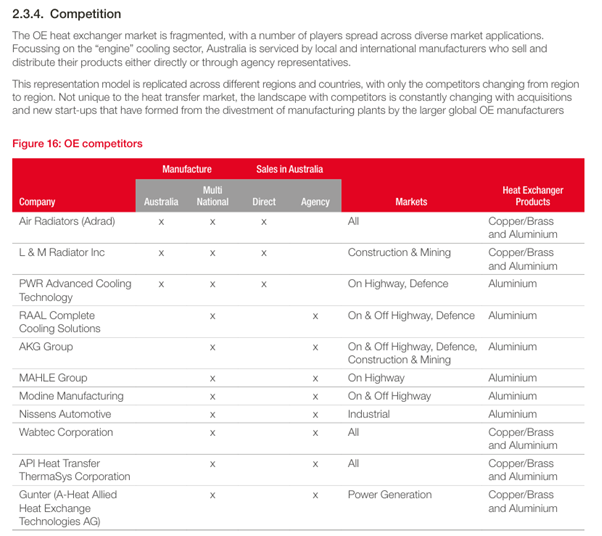
Market and Competition
· Distribution (Aftermarket): Adrad is concentrating on heat exchange products and being the go-to supplier of these products rather than a generalist supplier. IPO talked to expanding the product range but this has been abandoned for lack of competitive edge and the lack of cash and operating efficiency in pursuing this in a crowded market.
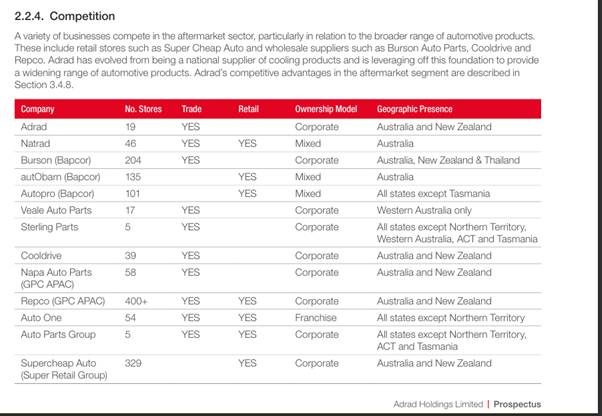
· Distribution is a crowded market with large dominant players in Trade and Retail. Adrad’s edge lies in specialising in cooling and as a channel for it’s OE manufactured parts at the high end.
· Heat Transfer Solutions (OE): Adrad is the largest and only significant supplier of large scale OE equipment in the Australian market. Specialising for designing and building for the Australian conditions (of which there are many).
· Kenworth: Adrad has been the specialist supplier of radiators to Kenworth Australia for 45 years via the brand Air Radiators.
· Alu Fin: A specialist aluminium cooling system for large (mega) underground mining trucks, Adrad is developing this specialist equipment for CAT in Australia which take time due to design and manufacture complexities but once established provides a long opportunity which can be expanded to other manufacturers of this equipment.
People & Ownership
Leadership Team:
· CEO: Darryl Abotomey (ex-Bapcor CEO of 10 years) who joined as a Director in April 2023 and from August 2023 has been acting in this role pending a replacement (Kevin Boyle who will start in April 2024 from 6 years as CEO at Blue Lake Milling a private company, but he has 20 years of manufacturing management and operations experience). The previous CEO was Donald Cormack and ex-E&Y partner was in the role for 15 years.
· CFO: Rod Hyslop joined in November 2022, good ASX listed experience, some manufacturing and GM, mostly Energy and started in industry then audit with AA.
· Chair: Glenn Davis, legal background with M&A, appointed in January 2022 for the ASX listing (Director of Beach Energy since 2007) – governance rather than operating skill set.
Director Ownership:
- · Gary Washington (Founder/ED): 49.3m shares (61%)
- · Donald McGurk: 0 shares
- · Glenn Davis: 0 shares
- · Darryl Abotomey: 0 shares
Disc: I own RL
Guess it is up to me to read the prospectus...
Other Equipment

Aftermarket

Despite the glowing story of Adrad's sector and the small market cap, maybe these tables explain why some of the financial metrics are still remaining in single digits.
Even more divided on this than before I think. Probably need to do more reading before deciding.
With the thought of NextDC still fresh on my mind

Not sure if "heat transfer" products would solve the cooling issue from DCs but one hopes that this could be a potential application.
Apart from that a few other "tidbits" I found since having this on my watchlist for 6 months but no time to write about it yet
Apologies for being too brief.and cryptic But worth spending your time understanding this company.
Hopefully I've piqued some interest, but don't mind if you give this straw a pass.
Not held but still thinking.