Company Report
Last edited a month ago
PerformanceCommunity EngagementCommunity Endorsement
ranked
#4
Performance (65m)
-12.8% pa
Followed by
139
Price History

Premium Content

Last edited 7 months ago
Valuation

Premium Content

Notes

Premium Content

Straws
Sort by:
Recent
Content is delayed by one month. Upgrade your membership to unlock all content. Click for membership options.
#EGM Notice (23/4/26)
Added a month ago

Todays price drop may have something to do with the notice of EGM (27 May).

Resolution 2 to reinstate the companies 15% placement capacity is the point of concern for shareholders as it suggests another capital raise. Resolution 1 seems to be a practical requirement to meet their bankers (CBA) needs for the combined group, I don’t see an issue.

Note that the placement limit is done on a rolling 12 month basis, so doesn’t reset at the end of the financial year. The company would have to wait 12 months from when the 19.5m share placement was issued (ie till 2 December 2026) before it would reset.

Looks like Mike has a full deal dance card! I wonder if an SPP will get a look in for the next deal?

They reaffirmed outlook: FY26 > FY25 & stronger FY27 with FY28 targets of $500m sales, EBITDA% of 8-12% and NPAT$ of 5-8%, so that looks ok.


That’s my summary of the key points, but you can read the EGM notice, alternatively the AI summary and analysis below has a lot more detail if you have the time.

Disc: I own RL+SM


Resolution 1 – Financial Assistance (HBT acceding to CBA facilities)

What it is

  • Stealth acquired 100% of Hardware & Building Traders Pty Ltd (HBT) on 10 November 2025, making it a wholly owned subsidiary.
  • Under Stealth’s existing Commonwealth Bank of Australia (CBA) debt facilities (Facility Agreement, General Security Deed and related documents), subsidiaries that meet certain earnings/asset thresholds must accede as guarantors and grant security over their assets.
  • Resolution 1 is a special resolution (75% approval needed) to allow HBT to provide “financial assistance” to Stealth by:
  • guaranteeing Stealth’s obligations under the CBA facilities; and
  • granting security over HBT’s assets in favour of CBA, and giving related undertakings/indemnities.
  • This approval is required under sections 260A and 260B of the Corporations Act because HBT is effectively supporting the financing arrangements used in connection with its acquisition.

Purpose

  • To ensure Stealth complies with its obligation under the CBA facility to bring HBT in as a guarantor (meets “Guarantor Coverage” tests).
  • To avoid an Event of Default and Review Event under the facility if HBT does not accede by 8 June 2026.
  • To avoid potentially costly and uncertain corporate restructuring to shift assets out of HBT if shareholder approval was not obtained.

Key implications for investors if Resolution 1 passes

Positive/neutral from a shareholder perspective:

  • Maintains access to existing debt facilities on current terms – Stealth remains compliant with covenants, reducing refinancing and repricing risk.
  • Avoids forced restructuring and additional cost – Stealth does not need to undertake a potentially inefficient internal restructure to move HBT assets into existing guarantor entities.
  • Supports group strategy and integration – HBT fully participates in the Stealth security group, facilitating funding, integration and delivery of the FY28 targets (>$500m sales, 8–12% EBITDA margin, 5–8% NPAT margin).

Risks/downsides (already typical for group financing structures):

  • HBT assets become security for group debt – if there is a default under the CBA facilities, CBA can enforce over HBT’s assets as well as other group assets.
  • HBT corporate flexibility is constrained – HBT will be subject to the same undertakings and financial covenants as other guarantor subsidiaries, which can limit standalone borrowing and certain corporate actions.

Net effect: Resolution 1 largely formalises standard group security arrangements for the acquisition; the main implication for investors is lowering financing and covenant risk versus a scenario where approval is not given (which could trigger default, forced refinancing or restructuring).


Resolution 2 – Ratification of prior issue of Shares under Listing Rule 7.1 (Placement)

What it is

  • On 2 December 2025, Stealth issued 19,500,000 fully paid ordinary shares at $1.00 per share, raising $19.5m before costs (the Placement).
  • The shares rank pari passu (same rights) with existing ordinary shares.
  • The Placement used Stealth’s 15% placement capacity under ASX Listing Rule 7.1.
  • Resolution 2 is an ordinary resolution to ratify that prior issue under Listing Rule 7.4.

Purpose

  • Under Listing Rule 7.1, Stealth can only issue up to 15% of its capital in any 12‑month period without shareholder approval.
  • Because the Placement did not fall within an exception and did not have prior shareholder approval, it has “used up” a portion of this capacity.
  • Ratification under Listing Rule 7.4 means the Placement is treated as if it had been approved beforehand, thereby “refreshing” the 15% capacity for future issues.
  • The $19.5m raised has been applied primarily to:
  1. Pay down a portion of existing debt, improving financial flexibility and reducing leverage; and
  2. Provide additional working capital to support rollout of the wholesale distribution strategy, particularly related to the HBT integration.

Key implications for investors if Resolution 2 passes

Impact on capital structure & future issuance capacity:

  • No change to current issued capital – the Placement has already occurred; ratification does not issue any new shares.
  • Restores Stealth’s full 15% placement capacity – Stealth regains flexibility to issue further equity (e.g., for acquisitions, growth capex, working capital) over the relevant 12‑month period without needing separate shareholder approval each time (subject to the cap and other rules).
  • Supports balance sheet strength and strategy – ratifying the issue effectively endorses the use of funds to reduce debt and fund the HBT‑linked wholesale distribution rollout, aligning with the FY26–FY28 growth and margin targets.

Risks/considerations:

  • Potential for future dilution – by restoring placement capacity, Stealth has more flexibility to issue additional equity in future, which could dilute existing shareholders if used.
  • Governance/discipline relies on the board – investors are relying on board discipline to only use the refreshed capacity where value‑accretive; there is no automatic requirement for shareholder approval for small‑to‑mid sized issues within the 15% limit.

If Resolution 2 does not pass:

  • The 19.5m shares remain validly issued, but they continue to “occupy” the 15% placement headroom, reducing Stealth’s ability to raise equity quickly without shareholder approval for at least 12 months from the placement date.


Overall investor implications if both resolutions pass

  • Financing risk reduced: Stealth remains in good standing with its CBA facilities, avoiding default and refinancing risk linked to HBT’s accession.
  • Strategic execution supported: Both resolutions support the HBT integration and the broader FY26–FY28 growth plan without signalling a need for further equity in the near term (the company states it does not currently anticipate needing another equity raise to execute its FY28 strategy).
  • Increased flexibility vs. increased optionality for dilution:
  • Resolution 1 enhances flexibility around group debt and security;
  • Resolution 2 restores flexibility to issue more equity quickly if needed, which can be either positive (funding growth) or negative (future dilution) depending on use.


#Thesis Review (17/11/25)
stale
Added 7 months ago

Thesis Review (17/11/25)

Original Thesis Review

Having spent most of my career in senior finance roles in import wholesale FMCG business’s, SGI was a business I felt I understood the fundamentals of if not the specific retail/product market, the key metrics for success and my thesis for SGI was centred on the delivery of these metrics and SGI as a founder business looking very long term and staying disciplined. It’s a game where very small % improvements make very big $ bottom line impacts.

Metrics & Thesis Focus:

·        Inventory Management: ensure inventory turns are high to reduce WC and the need to write off or sell at a discount old inventory (Inv write downs are red flags). 

·        Margin Discipline: Avoid discounting and margin deterioration, slows top line growth but the benefits at the bottom line are significant (no margin, no mission). Find ways to grow or protect margin (exclusive product, tool hire).

·        Operational Efficiency: Systems and process to manage hundreds of thousands or millions of inventory sku’s is critical and if done well is a point of difference/moat. It’s a commodity game for the most part so being the lowest cost supplier is the only place to be.

·        Scale Economies: Small margins, fixed costs requires adding scale to create operating leverage. Profit doubles if you take a 2% NPAT, improve margins by 1% and reduce operating costs by 1%. Build the efficient machine then jam as much as you can through it (the point Mike made at the AGM).

·        Leadership: Mike is a Founder, focused on his vision and long-term results driven plus a hard arse that only accepts the best outcomes for his business. Targets may not always be reached, but he isn’t going to undermine the long term to reach them for the sake of now.

·        Asymmetric Bet: Initially with a market cap of 10-20m on 100m sales, the asymmetry was clear that only a small operating leverage would create value. Only a fraction of the targets presented ever had to be achieved to still offer very good returns. Valuation matters.

In tracking SGI, Mike has stayed disciplined and focused on a lean, profitable wholesaling machine in which he can add through put via acquisitions for scale economies and has been disciplined on cutting loose low margin or inefficient sales.

#Sales Bridge
stale
Added one year ago

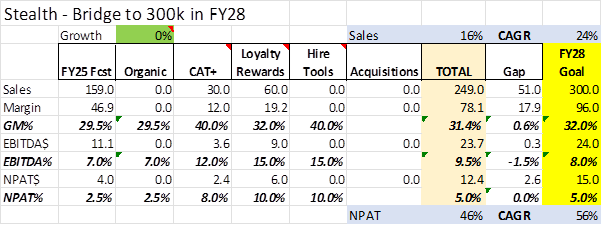
Below is a bridge of sales based on announced programmes from FY25 expected to FY28. I have only added values where SGI has provided targets to the market. There is a gap of $51m to reach the FY28m target, but there are three areas to fill this we already know of or can expect. No allowance is made for organic growth, the new hire business or additional acquisitions, plus we may see additional exclusive brand agreements over the next 3 years.

Reaching at least $250m by FY28 looks likely and the 300m target looks achievable without any heroic assumptions beyond what the company has executed on in the past.


159m: FY25 Expected Sales

60m: Loyalty Returns Program (Dec24 start, in progress)

Xm: New Hire Business ($ unidentified, possibly cannibalise sales but higher margins)

30m: New Exclusive Brands (Agreement secured, locked in)

Xm: 3-5% Organic (like for like) but store closures may offset so treat as nil

Xm: Acquisitions

249m+3X: Total FY28 Sales Bridge


6a7b41758ca39bad4bb9098e7f9093c2a5cec2.png

Loyalty Rewards Program

·        Launched Dec24

·        $60m annual new sales opportunity

·        From question at FY23 AGM, they are targeting 12-15% NPBT, >30% GP%

New Hire business (Hire One):

·        Target 4Q25 launch (in final testing phase).

·        20 new “store-in-stores” to open by Jun25

·        13 week payback period then 100% margin – expected to grow margin.

Own & Exclusive Brand Strategy:

·        EFM range (Force Technology)

·        H1FY25, exclusive products represented 5% of total revenue (>10% higher margins)

·        DullCo own-label mobile accessories launched in late 2024 in select IGA WA stores.

·        Distribution Agreements (CAT Power Tools, Wesco Power Tools & Harden Tools): Contract sell through arrangements for $30m in sales by 2028. Wholesale margins >40% and increase retail margins by 30-50%

·        RIVO (Big W & 7-Eleven) Brand: Starting with RIVO SAFETY (Collaboration with PIP Global Safety) a range of head-to-toe light industrial essentials


Disc: I own RL & SM

#FY24 AGM
stale
Added 2 years ago

The AGM recording is available: Stealth Group Holdings AGM 2024 - Webcast Recording on Vimeo

After market there are 35 buyers seeking 1.2m shares from 1 seller of 50k shares… gives you a feel for investor opinion on the results and AGM.

Mike focused on the FY25 to FY28 outlook and plan in his presentation, have a look. 

My takeaway is the focus on efficiency and growth that improves margins and profitability is the story, the same one as when I initially invested 3 years ago. The $60m sell through is still in the plan, starting in next 90 days under a new business “United Supply Company”.

Disc: I own RL+SM

#FY24 PE – Force Acquisition
stale
Added 2 years ago

Just looking at what the announcement says about the likely FY24 PE outcomes on both a pre acquisition and post acquisition proforma basis at the current 25c share price.

Note “transaction costs” are excluded – so this is based on the dreaded NORMALISED results


Vanila SGI (Pre-acquisition)

Sales of $159m less $44m expected for Force gives $115m (I was expecting $122m so a little off)

EBITDA of $8.5m less $2.64 (6% EBITDA) for Force gives $5.86m (I expected $5.94 so close)

Less Depreciation $3.2m and Tax $0.75m (my estimates)

NPAT = $1.91m (I had estimated $1.98m so confirmation bias is locked in Eddy)

PE = 12.5 (before dilution), 14.6 (post dilution)


Full Year Proforma (fully of both)

Assuming the same NPAT to EBITDA ratio as SGI has above: NPAT is 1/3 of EBITDA

Full year proforma EBITDA = $8.5m

NPAT = $2.83m (proforma full year estimate)

PE = 10.2 (post dilution)


The acquisition was a surprise at first – mobile accessories was the last thing on the mind, BUT – Stealth is a wholesale and logistics business for retail… so could make sense – will wait for tomorrows presentation to come to any real conclusions beyond the numbers look good and value is added on a proforma accounting basis.

Disc: I own RL+SM (largest positions for both…)

#AGM
stale
Added 3 years ago

Mike was clearly pumped by the recent share price performance so spoke with conviction and pride of the business's operating performance. Someone else will have to cover the detail and the Chair speech, I missed parts due to an annoying phone call.

The key take away for me was the 60m organic sales growth opportunity that will get them to the 200m sales target. I asked Mike about how they expected GP% to change as they took this up because I wanted to understand the quality of the opportunity. His answer was far better than the question and said with confidence and clarity that gave me an appreciation of the depth of work they have done in analysing the opportunity and understanding how their business will change in taking it up.

The essence of the response was that they don't look at it from a GP%, they look at NP% because they consider the whole of business effect from logistics, stock levels, cost to server in implementing it, etc and there are a variety of GP% for parts of the 60m but the end goal is NP% growth. Hence they are not just looking for top line growth to trickle down, but operating leverage on top of that. Which was a consistent theme when he talked about operations and things like store closures and the amalgamation of the Skip brand under Heatleys.

SGI has become my largest position but if I wasn't concerned about position weighting I would be a buyer at current prices. My valuation is north of 70c and assumes far less sales growth and lower EBITDA% than they continue to guide towards. I don't expect a price anywhere close to this for several more years at least, with a hell of a lot of volatility on the way.


Disc: Own RL & SM


#H1 Notes and Valuation
stale
Added 3 years ago

Thank you @Slideup and @Strawman for your notes on the H1 presentation, very helpful addition to what I got out of it. I will only add the impression I got that Mike (CEO) was very much in sell mode to drive the share price up (eg FY24 dividend…maybe). Not an all together bad thing but I think he over embellished on a few points. In particular I do not agree that Operating Cash flow or FCF are in a good spot, if you factor in lease principal payments (which for their business is a significant opex) FCF is +0.1, not +1.2m as shown on slide 11 and Op Cash is +0.7 not +1.7 as shown on slide 19.

Also, I am taking with a grain of salt that 95% of items sold are non-discretionary until we go through a downturn and that is proven. A global recession and pull back in business investment and commodity prices may test this theory for their customer base. I am sure they won’t be too badly impacted, but they will not be 95% immune.

Probably not big points to make, but I would prefer a more objective/frank view from the CEO which to my mind still has more than enough positive and avoids them feeling the need to focus on short term expectations to meet the hyperbole. As a shareholder I sympathies with his frustration at the markets indifference to valuing the business, but the numbers will do the talking when they start delivering them!


Outlook

None the less the company looks like it is pivoting from around break-even top line growth into what could be very rapid operational profit growth if it can deliver the margin expansion. However that also seemed imminent when @DrPete123 introduced it to the SM community – and I agreed with him and bought a small position. I note they still have the 8% EBITDA target for 2025 and sales have gone from 70m in 2021 to a likely 110m for 2023, mostly due to acquisition. So, I retain my faith in them and acknowledge they are very well positioned to reach that target especially if they can get the margin expansion talked about from acquisition integration, synergies, consolidation and leveraging their buying scale. 

A lot can go wrong with all that they are doing, and a recession will provide a headwind, but all the ingredients are there and their new scale should provide economies to expand margins one way or another as they absorb the acquisitions. So, let’s look at what happens if they meet there target or even get close:


Valuation

I have valued using a two methods, DCF at 10% and discounted PE of 15 from FY28 forecasted EPS figures to get the values. Assumptions for each noted.

Bull Case ($1.30-$1.37): They meet guidance of 25% sales growth and 8% EBITDA by 2025, then 10% pa Sales growth to 2028 terminal year and terminal EBITDA% of 10%. I doubt this will be possible without acquisitions which may require dilutive capital raises and impact on this valuation.

Base Case($0.60-$0.72): 10% Sales Growth to 2028, EBITDA% 6% by 2025 and 8.4% by 2028 terminal year. They have talked to a target of 10% organic growth, so assuming that they can do this and find margin efficiencies they have highlighted then I think this is achievable. For this scenario I assume capital rases to fund acquisition have a net zero benefit on a per share (ie dilution offset by additional growth)

Bear Case ($0.12-$0.23): Assume that sales grow at 10% still but efficiencies are minimal and EBITDA% only get to 4% by 2028. 

There is of course a case where it’s worth zero, where operational complexities add cost and recession or other external factors keep profits from growing or send them negative. The debt levels could also be a cause of business failure for reasons that may not be clear currently.

That said, I see SGI currently at a price of $0.12 as undervalued on a large range of possible outcomes and an asymmetric bet on the future. Not a lot needs to get better (only small margin growth and modest sales growth) to justify much higher values. 


Disc: I own SGI, having bought in Oct 2021 and have topped up recently following the H1 result, but that took 2 weeks given the lack of liquidity!!!


Side Notes on Reporting Matters

Inventory: I agree this is improving, but I don’t like it reported as a % of Sales, it should be a % of COS, that way movements in margins don’t impact your stock turn figures. Example is FY20 Vs FY22, Inventory measured as % of Sales was unfavorable 18% (11.6% to 14.2%) but as a % of COS was unfavorable 22% (15.8% to 20.3%)

Debt: I like the detail of the debt brake out, also the articulation of its use and management in the call. They are clearly and appropriately managing this closely which is great to see, and I think debt levels are reasonable currently, but I would be concerned if they grew from here. The splitting out of acquisition debt is informative but I don’t want to see an emphasis of debt excluding acquisition (inc WC support) as something that is highlighted as though the debt isn’t real debt (what is with Capital Risk Ratios that exclude acquisition debt – p22 of the H1 FY23 rep – maybe loan covenants metrics)!